
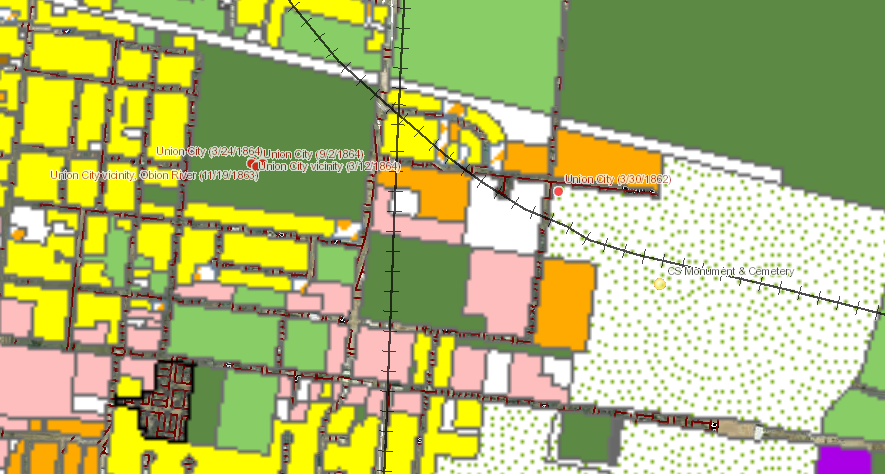
March 24, 1864 – Capture of Union City Note 1
Report of Capt. John W. Beatty, Seventh Tennessee Cavalry, of the capture of Union City.
CAIRO, ILL., April 12, 1864.
SIR: I have the honor to report to you that I have made my escape from the enemy after being surrendered, together with 16 officers and about 500 enlisted men, by Col. Isaac R. Hawkins, at Union City, Tenn., on the 24th of March, after fighting six hours and repulsing the enemy four times.
The enemy drove in our pickets at 4 a. m., 24th March, and skirmishing commenced soon after, and by sunrise our camps were entirely surrounded. Their force numbered about 1,500 commanded by Col.’s Faulkner, Bell, Duckworth, Faris [?], Freeman, Tansil and Russell.
They first made a charge, mounted, and finding that they were losing a great many men and horses, dismounted and made three unsuccessful charges with heavy loss in killed and wounded. Finding it impossible to rout our forces from their works, fell back great confusion, taking shelter behind fallen timber, stumps, &c., their sharpshooters keeping up a continuous fire until fifteen minutes to 11 o’clock when they ceased firing and sent in a flag of truce, demanding an unconditional surrender of our force, &c., giving Col. Hawkins fifteen minutes to make up his mind, stating that they would take the camp by storm as they had re-enforcements close at hand.
Col. Hawkins called together the officers and asked them what they were in favor of doing. I remarked if they had artillery they could whip us; if not they never could get inside our works. All the officers said fight except Maj. Thomas A. Smith.
Just at that time the telegraph operator said that they had two pieces of artillery; that he had seen them. Col. Hawkins said that it would save a great many lives if we would surrender, and that if we renewed the fight they would kill every one that might fall into their hands.
We the officers, then agreed, to surrender on condition that they would parole the officers and men and allow the men to keep their private property and the officers their side arms; otherwise we would fight as long as there was a man left.
Col. Hawkins then went out and met Duckworth at 11 o’clock, and ten minutes after 11 o’clock, the rebels came in, and Col. Hawkins ordered that all commanders of companies and detachments march their men outside of the fort, or works, and require them to lay down their arms.
Afterward we found that Col. Hawkins had made an unconditional surrender. The officers and men cried like a whipped child. They also cursed Col. Hawkins and said he was a traitor, and that they would never serve under him again.
At 12 o’clock the rebels burned our barracks and marched us via Jacksonville to Gardner’s Station, on the Nashville and Northwestern Railroad, a distance of 16 miles, where we camped for the night. Lieut.’s Hawkins and Helmer during their night made their escape.
On the next morning, March 25, at sunrise, we were marched 15 miles toward Trenton, Tenn., where we encamped for the night. The rebels gave our men about 1 ounce meat each, and no bread; this was the first that they at since the evening of 23d.
March 26, we started at sunrise and marched to Trenton, Tenn., where the citizens sold our men biscuits at $5 per dozen and baked chickens at $5 each.
March 27, we remained at Trenton during the day. The rebels drew our men up in line and marched them into court-house and searched each man as he went, in robbing them of their money, blankets, &c.
Lieut.’s Neely, Bradford, and Morgan made their escape at Trenton. Col. Hawkins said that he would have any officer dismissed from the service that would leave the rebels. They offered to parole Col. Hawkins at Trenton, but he refused to accept it.
The rebel officers told me that they knew they would get our regiment when they were 400 miles south of Union City, Tenn. They also said they were willing to parole Colonel Hawkins and let him get some more horses and arms and then they would come and get them.
March 28, we marched to Humboldt, a distance of 15 miles, where Capt. P. K. Parsons and myself made our escape.
JOHN W. BEATTY, Capt. Company K, Seventh Tenn. Vol. Cavalry.
OR, Ser. I. Vol. 32, pt. I, pp. 542-544.
Note1: The surrender of Union City to forces led by Nathan Bedford Forrest was said to be one of the most disgraceful and cowardly acts of any Union commander in Tennessee during the Civil War.


