
Narrative Citing Lytle and Jordan and Pryor Biographies of Nathan Bedford Forrest:
It had been raining for some forty days and the weather was intensely cold and the freezing mud and water was unbearable. The rivers were swollen, and Forrest would have to cross at a bridge to get his two hundred head of beef cattle, three hundred hogs and the recruits to safety.
Forrest marched forward to Jackson, Sommerville, and bivouacked at Whiteville. If Forrest was going to make his escape, it would have to be done the next day, and he must decide that night where he would make his “break through.” By Union command, all the bridges between Memphis and LaGrange had been burned to prevent Forrest from crossing the Wolf River and making his escape into Confederate territory (Lytle 253).
In the meantime, Forrest’s scouts reported that Prince was at Somerville with force of seven hundred and fifty, at Bolivar there was a body one thousand strong, as many at Middleburg and other troops were troops massed in Memphis and Charleston east of Moscow. At LaGrange three trains were filled with infantry still steamed to move in either direction. General Hurlbut was secure near Corinth, where the streams were shallow, and he expected Forrest to cross (Lytle 253).
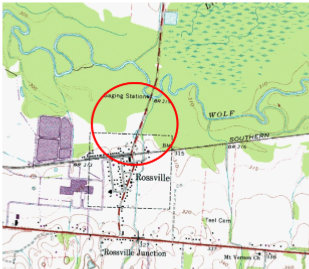
It appears that there was only one bridge remaining over the Wolf River between LaGrange and Memphis-that at LaFayette Station. Lieutenant John A. Williamson was sent with a small party to make a reconnaissance under cover of night.
Williamson crept between the Federal pickets and the bridge and found that the flooring had been removed and was piled up on the southern bank. While concealed by the brush, he observed a body of Federal reinforcements who approached the guards stationed in the mud fort within 30 feet of the bridge. They struck a light, and relayed the boards allowing the troops to pass. The boards were again removed and neatly stacked (Jordan & Pryor 375).
At dawn on December 27, 1863, Forrest divided his force. Colonel Bell was ordered to advance to LaFayette Station with two hundred men to seize the bridge. Two hundred additional men were sent in the direction of Moscow to make the enemy believe that Forrest intended to cross between Moscow and LaGrange, and to cover his real line of march. Major Strange was sent directly to Memphis with seven hundred troops to cross over the Raleigh Ferry and make an attack on the town and sweep south as fast as they could go (Lytle 255).
At eleven o’clock in the morning, Bell approached the bridge at LaFayette Station under the cover of a dense wood on the north bank. Without hesitation, Bell’s men splendidly charged across the timbers of the bridge under a volley from the fort. Only a single volley was fired.
The Federals observed the swarming numbers of yelping men who charged them at the outset, but they did not notice the unarmed condition of the main force. They quickly dashed for the road eastward toward Moscow leaving their strongly fortified position and four of their dead on the ground.
Colonel John Newsom was sent in pursuit with fifty men to give the proper appearance. Within two miles, Newsom encountered a troop train, which he attacked with such vigor to cause the train to reverse the wheels, and he destroyed the track (Lytle 255)
By four P.M., the bridge had been relayed and Forrest had succeeded in crossing with his cattle, hogs, wagons and troops. Forrest left some of his older men in LaFayette to simulate farm people who would give false information about the main body of Forrest’s train to any Federal troops. The main body of unarmed men took the road to Holly Springs by way of Mt. Pleasant with orders to make a night march (Jordan & Pryor 376).
The crossing at LaFayette was entirely unexpected by General Hurlbut, who did not dream that Forrest would have the audacity to drive his “unarmed mob and his wagons and drove of cattle to the door of his headquarters and within sound of the large garrison at Memphis.”
This was certainly a bold move by the General Forrest and “one of the cleverest pieces of strategy that Forrest practiced during the war” (Wyeth 264).
A Federal writer sums up the results of Forrest’s operations on this occasion in these terms: “Forrest, with less than 4000 men, has moved right through the Sixteenth Army Corps, has passed within nine miles of Memphis, carried off over 100 wagons, 200 beef cattle, 3000 conscripts, and innumerable stores, torn up railroad track, cut telegraph wire, burned and sacked towns, run over pickets with a single Derringer pistol, . . .and all too in the face of 10,000 men.” (Correspondent Cincinnati Commercial, Memphis, January 12, 1864.) (Jordan & Pryor 379-380).
“The Wizard of the Saddle had again done the unexpected and the impossible” (Lytle 257).
It has been the purpose of this paper to show the importance of the single bridge left at LaFayette Station as the only escape route for Forrest at this crucial point in the war. Many of the details of his one-hundred-and-forty-mile march with 3000 unarmed men, a large wagon train, cattle and 600 armed men has been omitted.
During this march his troops fought successfully five combats losing only an estimated 30 killed, wounded or captured. The bravery and loyalty of the men under Forrest is praised in numerous accounts.
“Forrest entered West-Tennessee at Saulsbury on the 4th of December with only some 500 men, two guns, and five ordnance wagons, and quit it at LaFayette Station on the 27th with 3500 men, well mounted, 40 wagons and teams loaded with subsistence, 200 head of beef cattle, 300 hogs, and his artillery intact” (Jordan & Pryor 379).