November 8, 1863.
Respectfully submitted to the President.
I am happy to relieve in some measure the anguish inspired by the news I was constrained to communicate this morning * by the more cheering intelligence of the within just received by me.
J. A. SEDDON.
This success may affect the movements of the enemy in front of General Jones.
J. D[AVIS].
Hdqrs. Dept, op Western Virginia and East Tenn., Dublin, December 11, 1863.
General: I have the honor to forward with this the reports of Maj. Gen. R. Ransom, jr., and his subordinate commanders of the attack on the enemy near Rogersville, Tenn., and the reports of Brig. Gen. John Echols and subordinate commanders of the battle of Droop Mountain, in Pocahontas County, W. Va. Both these affairs occurred on the same day (6th ultimo).
https://sharetngov.tnsosfiles.com/tsla/cwsb/1863-11-Article-57-Page76.pdf
The affair at Rogersville was a complete success and reflects great credit on the officers and men concerned.
With great respect, your obedient servant,
SAM. JONES, Major-General, Commanding.
General S. Cooper,
Adjt. and Insp. Gen., C. S. Army, Richmond, Va.
No. 6.
Report of Maj. Gen. Robert Ransom, jr., C. S. Army, commanding District of Southwestern Virginia and East Tennessee.
Hdqrs, Dist. Southwestern Virginia and East Tenn., Camp near Blountsville, Tenn., November 14, 1863.
Major: I have the honor to inclose reports of Brigadier-General Jones and Colonel Giltner relative to late attack upon the enemy at Rogersville. General Jones has supplied copies of my letters to him, and they accompany his report. Colonel Giltner’s report was sent to General Jones for indorsement. I inclose both the note of m.y adjutant-general to General Jones and his reply thereto: also my letter of instructions to Colonel Giltner.
I regret there should be any discrepancies in the two reports, but I am satisfied they are not irreconcilable. It was intended for the attacks by both brigades to be independent, but simultaneous, and of course when the two forces came together the senior officer was to take command of the whole. I did not intend to unite the brigades as my instructions show.
The result of the expedition is the best proof that it was conducted well, and I am unwilling to create or sustain bickering or jealousy when there should be mutual good feeling. General Jones was verbally instructed to change the point of crossing the river, if from fuller information it should become advisable.
The first report gave as captured 850 prisoners, 4 pieces of artillery, 60 wagons, and 1,000 animals. About 775 prisoners arrived, the artillery as at first reported, 32 wagons, and 3 ambulances. The regimental colors and our garrison flag are in my hands. One regimental flag was captured, but in some way lost.
I regret that up to this time I have been unable to have accounted for more than about 300 animals, all told. I much fear they were appropriated by the men and have been sent off and sold. There is no other reasonable conclusion.
The affair was a decided success, and I have thanked the officers and soldiers engaged in it.
Very respectfully, your obedient servant,
R. RANSOM, Jr.,
Major-General.
Maj. C. S. Stringfellow,
Assistant Adjutant-General, Dublin, Va.
[Inclosures.]
Hdqrs. Dist. Southwestern Virginia and East Tenn., Near Blountsville, Tenn., November 12, 1863.
Brig. Gen. W. E. Jones,
Commanding, &c
General: The major-general commanding directs me to inclose the report of Colonel Giltner for your indorsement, inasmuch as the two brigades were united in the latter part of the affair of the 6th instant. He requests that you forward your report of the /same affair as soon as possible.
Very respectfully, your obedient servant,
T. ROWLAND, Assistant Adjutant-General.
Headquarters Jones’ Brigade, November 13, 1863.
Maj. Thomas Rowland,
Asst. Adjt. Gen., Dist. of S. W. Va. and East Tenn.:
Major: In reply to yours, inclosing a report of Colonel Giltner relative to the attack on the enemy near Rogers vi]le, the 6th instant, I can say if by indorsement you wish me to confirm his statements, such is not in my power. My report will show you the affair appears to me in a different light from what it does to. Colonel GiltneL As the report is not addressed to me, and is not sent through me, I presume it was not intended I should correct errors in it.
I was under the impression I commanded in this affair, and the statement of Mr. Watterson will show Colonel Giltner was of the same opinion before the fight.
Very respectfully, your obedient servant.
W. E. JONES,
Brigadier-General.
Camp near Blountsville, November 3, 1863.
Brig. Gen. John S. Williams,
Commanding Cavalry Brigade:
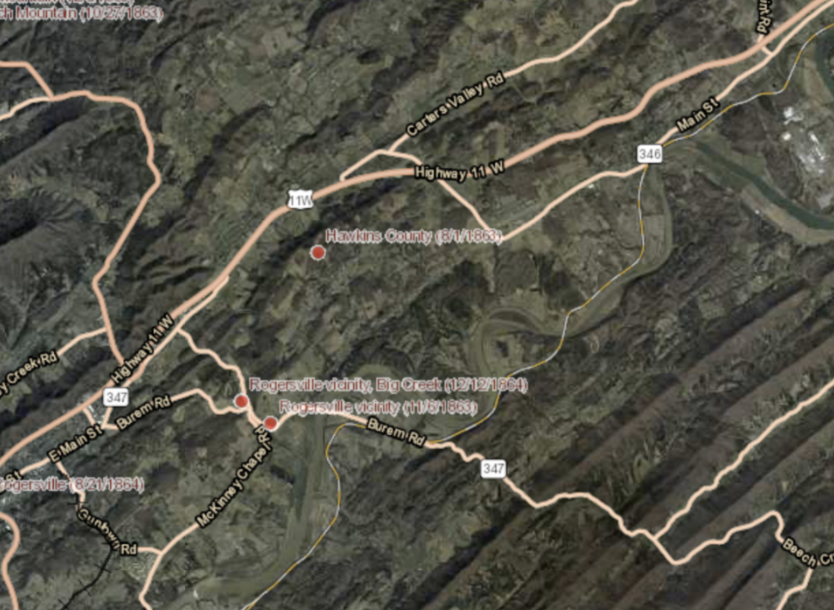
General: It is represented that there is at Rogersville a body of two or three regiments of the enemy, and it is desired to capture that force. You will drop down the river with vour brigade, having pickets at the fords, cross the North Fork or Holston, and attack at Rogersville at daylight in the morning of Friday, the 6th instant.
Brig. Gen. W. E. Jones will proceed by the Horse Creek and Beach Creek Valley roads and attack simultaneously with you. Your march after getting across the North Fork should be rapid and in the night. You can go a few miles below Kingsport, so as to reach Rogersville easily in the night of Thursday, and make the attack as directed.
No wagons except for ammunition will be taken. You can carry the battery now with you if you desire it. Have prepared enough cooked rations for the movement.
After executing the movement and the attack you will return rapidly to your present position. Concert between you and Brigadier-General Jones will be necessary. General Jones has been directed after the attack to return to his present position.
Very respectfully, your obedient servant,
R. RANSOM, Jr.,
Major-General.
[Indorsement.]
Hdqrs. Dist. Southwestern Virginia and East Tenn., Blountsville, Tenn., November 4, 1863.
Brig. Gen. John S. Williams having beem relieved of his command, aiid Colonel Giltner assigned to the command of his brigade, the latter officer will execute the order herein conveyed.
R. RANSOM, Jr.,
Major-General.
No. 7.
Report of Brig. Gen. William E. Jones, C. S. Army, commanding Cavalry Brigade.
Headquarters Jones’ Brigade, Near Carter’s Station, Tenn., November 13, 1863.
Major: In accordance with inclosed instructions from headquarters District Southwestern Virginia and East Tennessee, my command rendezvoused at Banchman’s Ford on the 4th instant. On inquiry finding if it crossed here there would be danger of alarming the enemy, I deemed it best to cross near Spurgeon’s Mill, and encamped for the night a few miles below.
Moving early next morning the command halted at Easly’s, on Horse Creek, 5 miles from, Kingsport, and fed the horses. From this point I communicated with Colonel Giltner near noon my intention to execute the original plan of attack.
Arriving 17 miles from Rogersville on the Beach Creek road near dark, we halted to feed and. cook rations. Here it was ascertained the road leading to Smith’s and Dodson’s Fords ran within 6 miles of the camps of the enemy. It was also ascertained both fords were difficult and dangerous, and the night was dark and rainy.
To reach the point assigned me by the hour designated required me to cross the Holston before daylight. By intricate mountain paths, exacting ‘the utmost care on the part of all, we reached the Long Shoals, 12 miles above Rogersville, and crossed in safety.
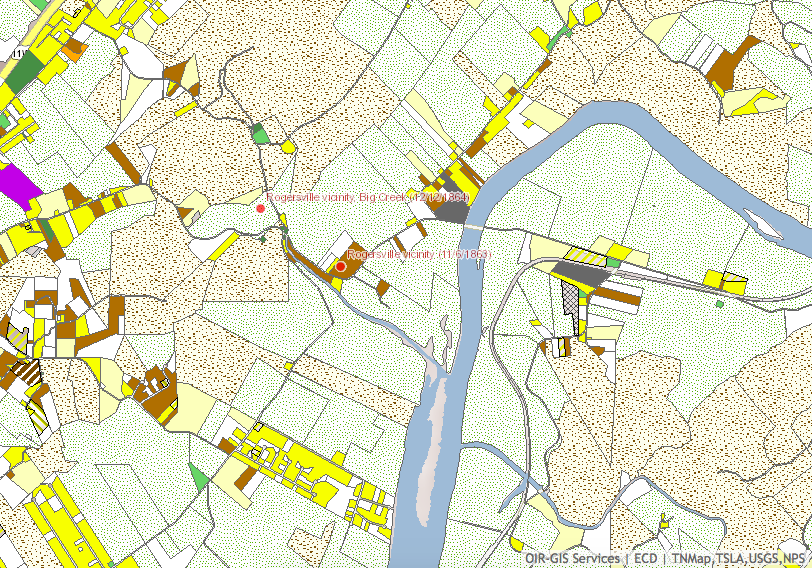
Reaching the old stage road, nothing could be heard of Colonel Giltner’s command, but I determined to turn the position of the enemy at the mouth of Big Creek by way of the Carter’s Valley road, my brigade crossing the old stage road for this purpose.
Soon a messenger overtook me with tidings of Colonel Giltner, also reporting about 100 Federal Tennessee home guards at Kincade’s. Pushing ahead part of the Eighth Virginia Cavalry to surround and capture this force, they encountered near where the home guards were expected a scout of 50 men from the Second Tennessee Federal Regiment. The attack was made with such vigor that but 17 men of this force escaped this onset.
Moving on briskly to the junction of the roads, the Eighth Regiment turned east on the old stage road and took position on the first eminence.
As it was now long after Colonel Giltner should have made his attack and no engagement could be heard, I felt assured the enemy, must have made his escape, but moved the Eighth across to the river road from Big Creek to Dodson’s Ford in hopes of intercepting fugitives.
The men of the Twenty-seventh Battalion Virginia Cavalry, under Capt. J. B. Thompson, were ordered to charge into Rogersville, and in so doing captured upward of 100 prisoners and some army supplies. For the same reason the Eighth was ordered to the river road.
Colonel Witcher was ordered with his own and the Thirty-seventh Battalion Virginia Cavalry to Smith’s Ford. The Thirty-sixth Battalion Virginia Cavalry was held in reserve near town, and the Twenty-first Regiment Virginia Cavalry in the position first held by the Eighth Regiment. The Twenty-seventh Battalion Virginia Cavalry was ordered, after the captures in Rogersville, by the railroad to the river.
After these dispositions had been made a party of 55 home guards (Federal) attacked the town from the west, but were easily dispersed by a small party under Lieut. W. M. Hopkins, aide-de-camp.
After all the prisoners had heen collected and marched out east of the town, the wagons loaded, hitched to, and driven to the forks of the main roads, was heard the first firing in the direction of Big Creek. The Twenty-first Regiment was immediately ordered up the old stage road with directions to be guided by the firing and to join in the battle. The Thirty-sixth Battalion was ordered up from town and all the other commands were recalled in haste.
The old stage road being open,rthe Twenty-first having moved across toward the river, a party of 125 of the enemy attempted to escape toward Rogersville, but were intercepted and all captured by the timely arrival of Witcher’s, Claiborne’s, and Smith’s commands.
By this time firing had ceased in front and I felt assured of the surrender of the enemy, as proved to be the case.
Two hundred and ninety-four prisoners were taken by my brigade, acting alone. The Eighth Virginia took 9 wagons and teams, 7 of which were secured. The remainder of the command took 3 wagons end 2 ambulances, all of which were secured.
From Colonel Corns’ report it will be seen the roads west of the position of the enemy were held by the Eighth Virginia Cavalry, and a large part of the 556 prisoners taken here were taken by the Eighth and sent in charge of an officer to Colonel Giltner.
Had Colonel Giltner made a prompt and bold attack that would have discovered the position of the enemy before my dispositions were made, under the impression of his having abandoned his position, it is believed none would have escaped. The unaccountable delay, doubtless, has proved very detrimental to our interests.
To Captain McKinney, of General Jackson’s staff; to Mr. W. H. Watterson, clerk of my brigade quartermaster, and to Mr. Fipps and other guides my thanks are especially due for their activity, energy, and judgment on this occasion.
To Lieut. W. M. Hopkins, of my personal staff, I am under great obligations for the efficient discharge of his official duties.
Very respectfully, your obedient servant,
W. E. JONES, Brigadier-General.
Maj. Thomas Rowland,
Asst Adjt Gen., Dist. S. W. Fa., and E. Tenn.