
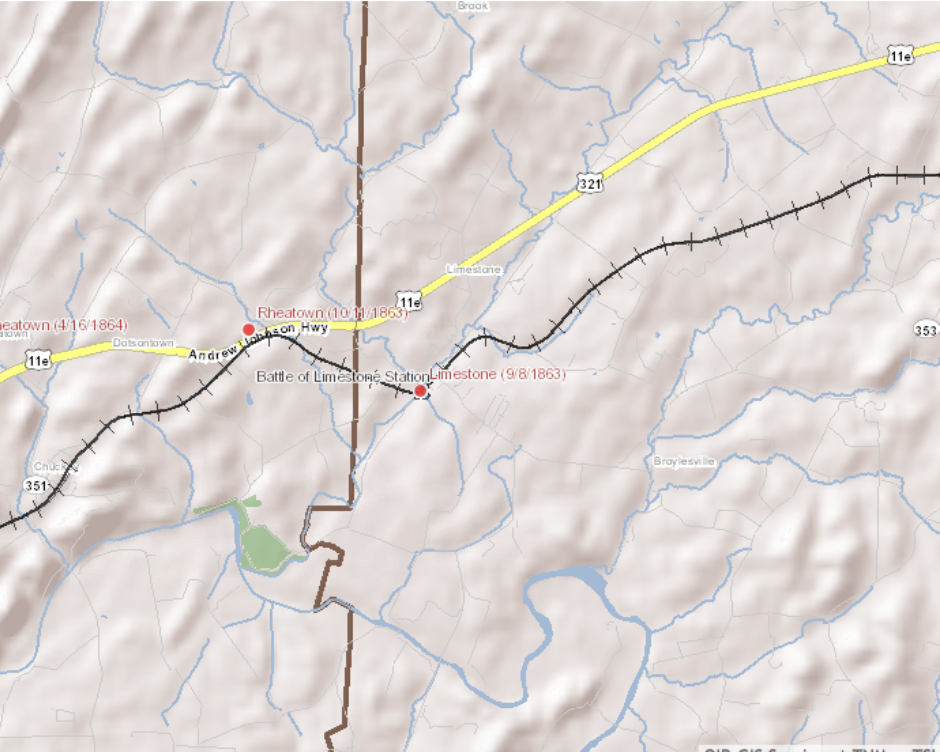
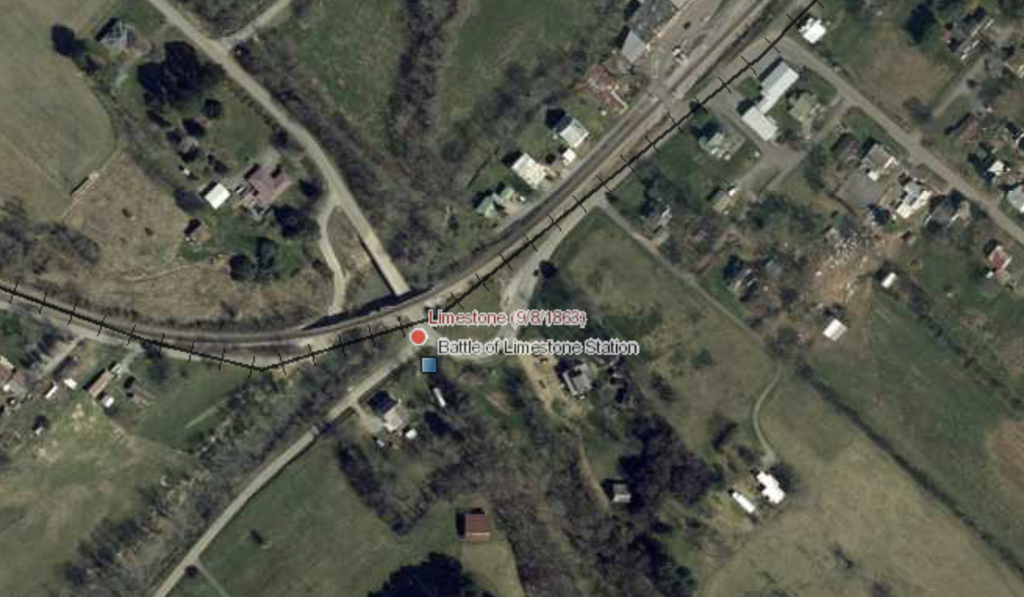
September 8, 1863 – Action at Limestone station Note 1 and skirmish at Telford’s station
Report of Colonel John W. Foster, Commanding the Second Cavalry Brigade
concerning the actions at Telford Station and Limestone Station.
MORRISTOWN, TENN.,
September 9, 1863.
GEN.: I sent you on yesterday the report of Lieut.-Col. Hayes, One hundredth Ohio
Volunteers, of the engagement between a detachment of his regiment and the rebels near Limestone Station on yesterday [8th] morning. I pressed on with the One hundred and third Ohio as rapidly as the inferior capacity of the engine would permit, but our progress was slow and we did not arrive at Henderson’s Station until midnight [9th] when we found the bridge at that place partially destroyed and the track burned. After considerable delay, I succeeded in repairing the injuries sufficiently to cross the train. Passing on 2 miles, I found the bridge over Ripley Creek burned and totally destroyed. I was therefore compelled to disembark my men in order to proceed any farther. Upon my arrival at this place (Ripley Creek), I heard the report that the One hundredth Ohio had been taken prisoners. I pressed on with the intention of relieving the regiment or ascertaining the exact condition of it. When near the scene of the last fight I learned the report to be true. After the fight of the morning, Lieut.-Col. Hayes withdrew from Telford’s to Limestone Station. At half past 1 p. m. [9th] he was again attacked by the enemy, who had been considerably re-enforced. After an engagement of two hours and a half he was compelled to surrender to the enemy. Their force is variously estimated at from 1,000 to 1, 800, having two Parrott guns and three mountain howitzers. The force of the enemy was chiefly mounted men. From all I can gather the defense of Lieut.-Col. Hayes was very determined and stubborn, he only yielding after a protracted engagement to an overpowering force. Before the surrender the enemy had destroyed the railroad for 6 miles in his rear, and he was entirely surrounded. I cannot learn definitely the loss of killed and wounded, but do not think it very heavy. The number of prisoners taken was about 200. One company that went up was guarding Lick Creek Bridge and escaped capture, with probably 20 others. I approached near to the pickets of the enemy, and found them camped near the battle-field in force. The One hundred and third Ohio with me had a fighting force about 375 men, one company having been left at Morristown, and as the force of the enemy was reported at the lowest estimate over 1,000 with five pieces of artillery, I deemed it entirely imprudent to risk an engagement, especially as my chief object was to occupy a location on the railroad as a base of operations for my cavalry and protect the road. I intended to attempt to hold Henderson’s Station, but upon withdrawing to it I ascertained that the enemy was moving upon my flank and rear with 700 or 800 cavalry, with the evident design of burning the bridges and trestle below Greeneville and destroying the road, cutting off my communications by railroad. As I was entirely powerless against cavalry with such an object in view, I saw no alternative but to withdraw or suffer the fate of the One hundredth Ohio. I accordingly withdrew the One hundred and Third Ohio, with my entire train, and have stationed it at Lick Creek and Seven Pond Bridges, being the most important bridges nearest to Greeneville. There are two trestles near Greeneville, which should be guarded, but it would be too hazardous to weaken and scatter my already too inferior force. I hope to be able to preserve the entire line of railroad to Greeneville to-night, but you can see difficulty of guarding 75 miles of road with so small a force against 1, 200 or 1,500 cavalry. I have brought the train down to this place and will load it with one section of Colvin’s battery, and 50 cavalry of my brigade, which will arrive here to-night and re-enforce the One hundred and Third Ohio. If the road is not destroyed this evening I will advance to-morrow and occupy and hold Greeneville. It is reported that the enemy at Bristol has been re-enforced by troops from Richmond, but I place no confidence whatever in the rumor. I think that after my demonstration at Carter’s on Sunday last, the enemy saw the necessity of destroying the road, and have accordingly collected the whole available mounted force at and in the vicinity of Bristol and Saltville for this purpose. The road is destroyed as far as bridges are concerned as far down as Greeneville. I hope my brigade will be assembled in three days at Greeneville, and as soon after as possible I will commence offensive operations. I have entire confidence in my ability, when so organized, to drive the enemy back, and if they have not been re-enforced from the east or Cumberland Gap, to capture Bristol and the salt-works. You can rest assured that the campaign shall not fail for want of vigilance and energy on my part. I trust you may permit me to carry out your original order as far as possible. If you have heard that the Fifth Indiana Cavalry is not moving up promptly, please order them to report to me at Greeneville, at once. Expedite the movement of the Ninth Ohio Volunteer Cavalry, and the detachments of my command left behind as much as possible. I send my locomotive down with this dispatch. The telegraph wire does not work down to Morristown; it may be the wire may be down. I have instructed the officer in charge to return at an early hour tomorrow and look carefully to the line. I will return to Lick Creek Bridge tonight.
Very respectfully,
JOHN W. FOSTER, Col., Comdg. Second Cavalry Brigade.
OR, Ser. I, Vol. 30, pt. II, pp. 590-591.
Excerpt from Itinerary of the Twenty-third Army Corps, August 1-September
30, 1863.
~ ~ ~
September 7.-. . . a detachment of the One hundredth Ohio Volunteer Infantry, under Lieut.-Col. Hayes, was sent east on the East Tennessee and Virginia Railroad, to Limestone Station, where, on the 8th, they were attacked by superior forces of the enemy and compelled to surrender. Losses, 3 wounded, 17 commissioned officers and 263 enlisted men captured. September 8.-Lieut.-Col. Hayes, One hundredth Ohio, and 300 men had a skirmish at Telford’s Station with 1,500 of the enemy, under Gen. Jackson; 1 killed and 2 wounded. Thirty of the enemy killed and wounded. Fell back to Limestone Creek, to await re-enforcements. Fought the enemy, 1, 800 strong, for two hours, and then surrendered. Loss, killed, wounded, and taken prisoners, 200 men. Col. Crittenden to Sevierville.
~ ~ ~
OR, Ser. I, Vol. 30, pt. II, p. 578.
Report of Lieut. Col. Milton A. Haynes, C. S. Artillery.
HDQRS. ARTY. FOURTH DIST., DEPT. OF EAST TENN., Jonesborough,
September 12, 1863.
SIR: In obedience to the orders of the brigadier-general commanding, I have the
honor to inclose to you the reportNote 2 of Lieut.’s Blackwell and Graham, of Burroughs’ battery, in regard to the engagement with the Federal force commanded by Col. Hayes, of the One hundredth Ohio Regt., on the 8th instant. These officers have detailed the incidents of the 8th so well that I have but little to add. On the 6th, as you know, our whole force was at Bristol, on which day we marched to Jonesborough, arriving there on the morning of the 7th. The enemy had already been in Jonesborough, taken away many citizens prisoners and carried them off, and having possession of the trains south of Jonesborough, they told their Union friends (as reported to us) that they would be back on the 8th. Many citizens had been despoiled by the enemy, and my forces were anxious to avenge their wrongs. At 2 o’clock on the morning of the 8th, Gen. Jackson sent me an order requiring me to send immediately forward one piece of artillery. I sent a 6- pounder with 60 rounds and went myself to see them off, but at the general’s headquarters I was met by one of his officials, who told me I was ordered to remain in charge. I returned to my quarters, and early in the morning I heard the sound of artillery and then of small-arms. An order soon came requiring two companies of infantry, which were sent. About 8 o’clock in the morning a messenger came from Gen. Jackson, saying: “Send me all your artillery and all the infantry except one company.” My artillery was already harnessed and every man at his post, and at the word they were on the march, and Lieut.-Col. Walker’s battalion, North Carolina Volunteers, 300 strong, followed. Arriving at Telford’s Station, where we had the battle of the morning, we saw our wounded and heard that the enemy were in retreat, and that Gen. Jackson was in pursuit. Not knowing in what direction friends or foes had gone, we pursued in a gallop, and at about 9 o’clock we heard the discharge of artillery at Limestone Bridge. Pursuing our course as rapidly as possible, we soon came to the scene of action and placed our pieces in battery. At that moment Col. Giltner, of the Kentucky cavalry, with his men, dismounted, was engaged with the enemy on the opposite side of Limestone Creek, cutting off the communication of the enemy by railroad south. Soon after Col. Walker came up with his men, who had marched at double-quick time 12 miles.
At my suggestion they were ordered to lie down and rest for thirty minutes, and during that time the enemy’s sharpshooters were firing upon our battery, and we were amusing them by a few discharges of spherical case-shot. As soon as Col. Walker’s men had rested, they deployed as skirmishers to the left to clear the woods, and Maj. McKamy’s battalion on the right to sustain the battery. [The enemy] at that moment had possession of a skirt of woods in front of the block-house and stone and brick buildings occupied by them as barracks, distant about 1,000 yards from our position. The infantry, advancing as arranged, charged the enemy’s skirmishers, the battery covering them by throwing case and canister into the woods occupied by them. With a shout and a hurrah for the Bonnie Blue Flag, the North Carolina boys made the charge, and the enemy fled before them, as you and the general well know. The enemy, being now within the blockhouse and other houses, were pouring upon us a shower of Minie balls. When we had thus driven the enemy into their last retreat (Col. Giltner, with his gallant Kentuckians, accompanying to the other side of the creek), I brought the guns of Burroughs’ battery (then under Blackwell) into position, and opened fire upon them with spherical case and canister shot, Col. Giltner’s small rifled guns joining in the action.
The enemy in the meantime kept upon us a very sharp fire of small-arms (Enfield), and then (as Sterne says) a white flag appeared. By order of Gen. Jackson, I went down, accompanied by Capt. Robert W. Haynes, aide-de-camp, and accepted the side-arms of near 350 Yankee officers and soldiers, the remnant of 450 who began the fight in the morning. Among the men who by their gallantry contributed to this result were Lieut. Col. James L. Bottles and Capt. Jenkins, both volunteers for the occasion, but men whose bravery could not be exceeded. Our troops of all arms behaved with becoming courage, and all within their sphere contributed to the general and honorable result, among whom I ought not to leave out, and do not leave out, the names of the gallant Lieut.-Col. Winn, of Georgia, Col. Giltner, of Kentucky among whom and over all of us was the gallant commanding general.
I have the honor to be, very respectfully, your obedient servant,
MILTON A. HAYNES, Lieut.-Col., P. A., C. S., Comdg. Art.
OR, Ser. I, Vol. 30, pt. II, pp. 643-644.
Note 1: A. k.a. Limestone Bridge.
THE BATTLE OF LIMESTONE STATION
By James Maddox, Johnson City, Tennessee
On August 29, 1863, Landon C. Haynes, Confederate Senator from Tennessee, telegraphed President Jefferson C. Davis: “The Federals have taken Knoxville. By this time East Tennessee is surrendered. Bragg’s army is separated from upper East Tennessee. From Knoxville up to Abingdon, VA., is held by a very small force.” Haynes asked for protection from the iron, niter, salt and lead industries in the area so crucial to the Confederate war effort. “Can it be done?” he asked. “I earnestly urge it.”
The “very small force” Haynes mentioned consisted of two small brigades, one under the command of Brig. Gen. John W. Frazer, stationed at Cumberland Gap, and another commanded by Brig. Gen. Alfred E. Jackson, of Washington County, scattered along the East Tennessee and Virginia Railroad. Frazer’s brigade was soon surrounded by Union forces commanded by Maj. Gen. Ambrose E. Burnside and surrendered on September 9. The defense of East Tennessee would depend on Jackson’s brigade and whatever support could be spared from Confederate forces in Southwestern Virginia.
Jackson’s brigade consisted primarily of a regiment and battalion from Thomas’ Legion, mostly men from the mountains of western North Carolina, the 16th Georgia Cavalry Battalion, Captain William H. Burrough’s Light Artillery Company and portions of two dismounted batteries. Jackson was ordered to retreat to Bristol to await reinforcements, arriving there September 3. A small force of artillery and infantry under the command of Captain Hugh L. McClung was left behind to guard the bridge at Carter’s Depot in Watauga.
In the meantime, Federal infantry pushed forward on captured trains to Jonesboro, arriving there on September 5, where a small skirmish ensued with Rebel cavalry, during which the Richmond Enquirer reported: “Two females were wounded by the Yankees in the encounter.” The Federals went on to Watauga, their commander demanding the surrender of Carter’s Depot, “In the name of Maj. Gen. Burnside,” which Captain McClung promptly refused, whereupon the Federal troops retreated back towards Jonesboro.
Major William Stringfield set out from Carter’s Station on September 6, as recorded in his dairy: “Jonesboro. At daylight this Am I took 75 cavalry and started in search of the Yankees – but ‘nary Yank’ do I see; I first galloped through the town – midst the smiles and cheers of beautiful women and waving of handkerchiefs. I remained in town all day and on Picket below town most of the night.”
From Bristol, an anxious Gen. Jackson wired Lt. Col. James R. Love at Carter’s Station: “Urge the holding of Carter’s Depot at all hazard but if it should have been given up hold on to Zollicoffer to the last. Large reinforcements are coming.” The regiment commanded by Love had spent most of their service guarding bridges and on provost duty and Love probably spoke for his men when he sent a courier back to Jackson with the message: “Push forward the cavalry and let us have some fighting. The force of the enemy at Jonesboro cannot be more than 400.”
The Union regiment that Love’s North Carolinians would soon be fighting was the 100th Ohio Infantry. Like most of the men of Jackson’s brigade, the men of the 100th had seen little or no action. Organized in and around Toledo, Ohio, from July to September of 1862, the regiment had seen plenty of hard marching in Kentucky, mostly in response to Confederate cavalry raids. But for the regiment and its commander, Edwin L. Hayes, this was to be the first real fight.
When the retreating Federals realized the rail route to Greeneville was blocked by a burning railroad trestle, the 100th Ohio halted at the old Embree stone house at Telford and began digging in, to guard the rail line and wait for reinforcements.
Jackson, meanwhile, had been reinforced by the 4th Kentucky Cavalry, under Col. Henry Giltner, the Schoolfield’s battery. Jackson arrived at Jonesboro on the 7th.
The next morning he sent the 4th Kentucky Cavalry and Lt. Col. Love’s North Carolina infantry to attack the 100th Ohio at Telford. The fighting was brisk, with Jackson sending orders back to Jonesboro to send forward two companies of William C. Walker’s battalion, which had been held in reserve.
The Federals were driven back some six miles to the bridge at Limestone Station, and Jackson sent a message to Lt. Col. Milton A. Haynes at Jonesboro, which he received at 8:00 to bring Walker’s battalion and the artillery. Haynes arrived at Telford’s Station, “where we had the battle of the morning, we saw our wounded and heard that the enemy were in retreat, and that General Jackson was in pursuit.”
Lt. Col. Haynes continued: “No knowing what direction friends or foes had gone, we pursued in a gallop, and at about 9:00 we heard the discharge of artillery at Limestone Bridge. Pursuing our course as rapidly as possible, we soon came to the scene of action and placed our pieces in battery. At that moment Col. Giltner, of the Kentucky cavalry, with his men, dismounted, was engaged with the enemy on the opposite side of Limestone Creek, cutting off communication of the enemy by railroad south. “Soon after Col. Walker came up with his men, who had marched at double-quick time 12 miles. At my suggestion they were ordered to lie down and rest for 30 minutes, and during that time the enemy’s sharpshooters were firing upon our battery, and we were amusing them by a few discharges of spherical case-shot.”
Lt. Col. Haynes described the battle from that point: “As soon as Col. Walker’s men had rested, they deployed as skirmishers to the left to clear the woods and Major McKamy’s battalion on the right to sustain the battery. (The enemy) at that moment had possession of a skirt of woods in front of the block house and stone and brick buildings occupied by them as barracks, distant about 1,000 yards from our position. The infantry, advancing as arranged, charged the enemy’s skirmishers, the battery covering them by throwing case and canister into the woods occupied by them. “With a shout and hurrah for the Bonnie Blue Flag, the North Carolina boys made the charge and the enemy fled before them, the enemy being now within the block house and other houses, were pouring upon us a shower of mini balls. When we had driven the enemy into their last retreat (Col. Giltner, with his gallant Kentuckians, accompanying to the other side of the creek), I brought the guns of Burrough’s battery… into position, and opened fire upon them with spherical case and canister shot, Col Gilner’s small rifled guns, joining in the action. The enemy in the meantime kept upon us a very sharp fire of small arms (Enfield), and then …a white flag appeared.”
Major Stringfield reported in his diary that “after a stubborn fight of two hours we captured 290 prisoners, 30 wounded and 20 killed of them. Our losses six killed and 15 wounded. I took a splendid sword from the commander…also a good gum cloth.
The enemy fought well (and) were evidently commanded by a veteran.”
Of the 100th Ohio only a few escaped capture. Local historian John Fain Anderson wrote of an interview with Nolichucky River ferryman Nicholas Earnest, who helped the men escape. Earnest “crossed them over and took their names down in his book -35 of them – all most entirely exhausted, the worst besmeared men he had ever seen.”
After the battle, the Ohio troops were placed aboard a train bound for the prisons in Richmond. The North Carolinians and Kentuckians lost little time in replacing their weapons with the new Enfields captured from the Federals. Washington County native Col. J.L. Bottles who was very familiar with the Limestone area was mentioned in official reports as “among the men who by their gallantry contributed to this result men whose bravery could not be exceeded.”
The main result of the Battle of Limestone Station was the morale boost and badly needed equipment it gave the men of Jackson’s command who had long been described in official reports as “utterly unreliable.” Union commanders would never again underestimate Confederate capabilities in upper Tennessee, and lost little time in mounting another attack, this time with a sufficient force of cavalry.
Northeast Tennessee, however, with brief exceptions, would remain under Confederate control until the spring of 1865.
The real tragedy of the Battle of Limestone lay with the Ohio men who were captured. While the rest of the 100th Ohio went on to fight at the siege of Knoxville, the Atlanta campaign and the battles of Franklin and Nashville, those men who were originally sent to Confederate prisons in Richmond, were later transferred to the dreaded Andersonville Prison. Eighty-five men of the 100th Ohio Infantry would die in Confederate prisons.


