Official Reports of the Campaign in North Alabama and Middle Tennessee, November 14, 1864-January 23, 1865
No. 232. — Reports of General John B. Hood, C. S. Army, commanding Army of Tennessee.
RICHMOND, VA., February 15, 1865.
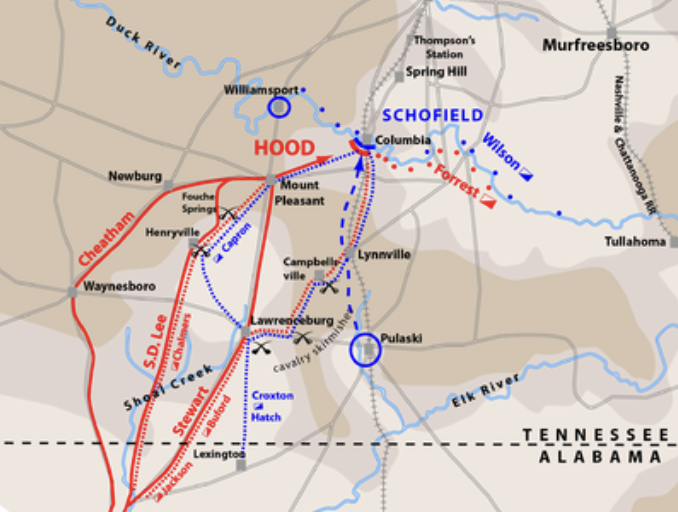
GENERAL: Forrest’s cavalry joined me on the 21st of November and the movement began, Major-General Cheatham’s corps taking the road toward Waynesborough, and the other two corps moving on roads somewhat parallel with this, but more to the eastward, with the cavalry under General Forrest in the advance and upon their right flank.
The enemy’s forces at this time were concentrated at Pulaski, with some force also at Lawrenceburg. I hoped to be able to place the army between these forces of the enemy and Nashville; but he evacuated Pulaski upon the 23d, hearing of our advance (our cavalry having furiously driven off their forces at Lawrenceburg), and moved rapidly by the turnpike and railroad to Columbia.
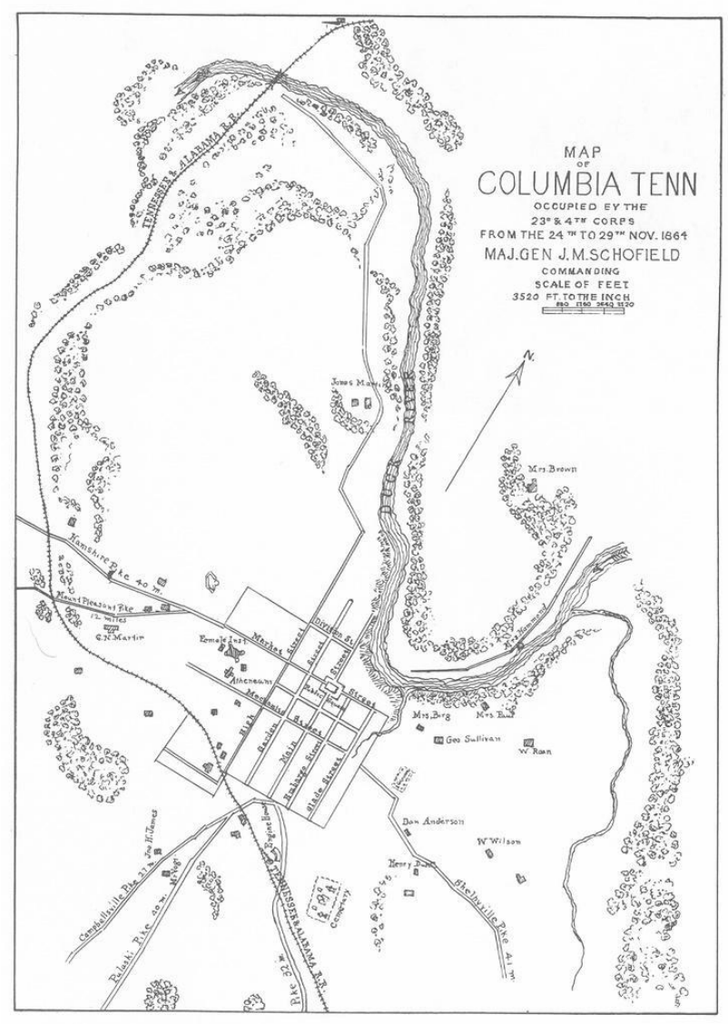
The want of a good map of the country, and the deep mud through which the army marched, prevented our overtaking the enemy before he reached Columbia, but on the evening of the 27th of November our army was placed in position in front of his works at that place.
During the night, however, he evacuated the town, taking position on the opposite side of the river about a mile and a half from the town, which was considered quite strong in front.
Late in the evening of the 28th of November General Forrest, with most of his command, crossed Duck River a few miles above Columbia, and I followed early in the morning of the 29th with Stewart’s and Cheatham’s corps, and Johnson’s division, of Lee’s corps, leaving the other divisions of Lee’s corps in the enemy’s front at Columbia.
The troops moved in light marching order, with only a battery to the corps, my object being to turn the enemy’s flank, by marching rapidly on roads parallel to the Columbia and Franklin pike, at or near Spring Hill, and to cut off that portion of the enemy at or near Columbia.
When I had gotten well on his flank the enemy discovered my intention and began to retreat on the pike toward Spring Hill.