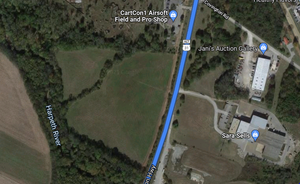
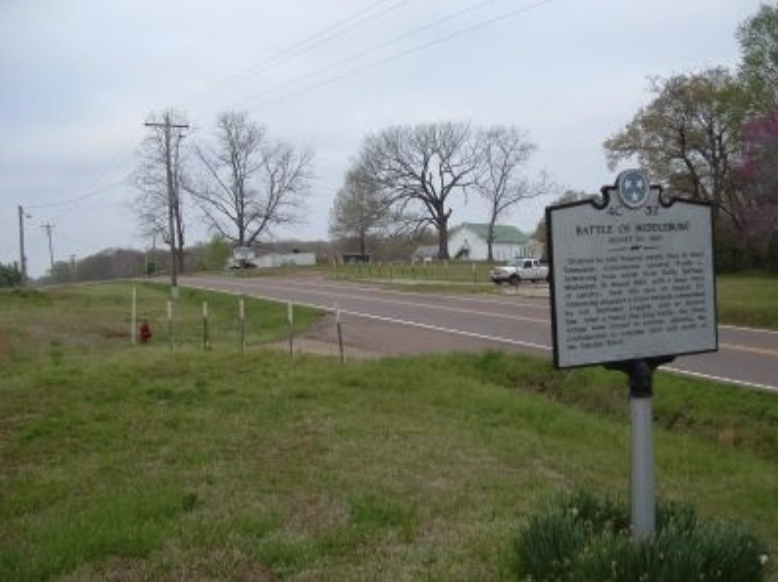
Inscription: Ordered to raid Federal supply lines in West Tennessee, Confederate General Frank C. Armstrong rode north from Holly Springs, Mississippi in August 1862, with a large force of cavalry. Near this spot on August 30, Armstrong engaged a Union brigade commanded by Col. Mortimer Leggett, sent to destroy him. After a fierce day-long battle, allowing the Confederate to continue their raid north of the Hatchie River. Tennessee Historical Commission. (Marker Number 4C 32.)
August 30, 1862 – “I may also say that the mounted infantry or ‘Mule Cavalry’ proved an entire success.” Skirmish near Bolivar. Note 1
HDQRS. FIFTH DIVISION, Memphis, Tenn., September 4, 1862. Col. J. C. KELTON, Asst. Adjt. Gen., Hdqrs. of the Army:
DEAR COL.: All seems well here and hereabouts. No large body of the enemy within striking distance. A force of about 2,000 cavalry passed through Grand Junction north last Friday, and fell on a detachment of the Bolivar army at Middleburg, the result of which is doubtless reported to you. As soon as I heard of the movement I dispatched a force to the southeast by way of diversion, and am satisfied, that the enemy’s infantry and artillery fell back in consequence behind the Tallahatchie.
W. T. SHERMAN, Maj.-Gen. OR, Ser. I, Vol. 17, pt. II, p. 200. Note 2
Note 1: This cavalry-infantry-artillery “skirmish” lasted about seven hours.
Note 2: See also: Albert Castel, ed., “The War Album of Henry Dwight, Part IV,” Civil War Times Illustrated, Vol. XIX, No. 3, 1980, pp. 32-36.
Report of Col. Mortimer D. Leggett, Seventy-eighth Ohio Infantry, commanding First Brigade, of skirmish at Bolivar, Tenn., August 30, 1862. Note 1
HDQRS. FIRST BRIGADE, Bolivar, Tenn., September 1, 1862.
SIR: I have the honor to report that about 7 o’clock a. m. of August 30 I received from you orders to take a portion of my command, one section of the Ninth Indiana Battery and two companies of the Eleventh Illinois Cavalry, and drive back a force of rebel cavalry, reported to be about 400 strong, upon the Grand Junction road and near our lines.
Col. Force, of the Twentieth Ohio, having received information that a small rebel force was menacing our pickets, very properly took the responsibility in my absence of sending out two companies, under Maj. Fry, of his command, to guard the lines and feel of the enemy. On arriving at my headquarters I immediately sent 45 of my mounted infantry to support the two companies sent out by Col. Force, and followed as rapidly as possible with the balance of the Twentieth Ohio and three companies of the Seventy-eighth Ohio, leaving orders for the remainder of the Seventy-eight Ohio to be ready to march at a moment’s notice.
The cavalry and artillery had orders to meet me at the picket post at the Grand Junction road, but on arriving at that point I found that neither had got there. I left the infantry at that point under command of Col. Force to escort the artillery when it should arrive. With my staff I pressed rapidly on to the front to prevent, if possible, an engagement until my main force could come up.
When I reached the advance I found the two companies of the Twentieth Ohio and the mounted infantry deployed in a piece of woodland on the Van Buren road, about 5 1/2 miles from Bolivar, and briskly skirmishing with the enemy. I immediately discovered that we had been deceived as to the number of the rebels, and sent back for the balance of my command to come forward as rapidly as possible. Shortly afterward two companies of the Eleventh Illinois Cavalry, under Maj. S. D. Puterbaugh, numbering in all 40, came up.
The nature of the ground being such that cavalry could not be used, some 12 or 14 of those who had carbines dismounted and formed with the infantry. After driving the enemy steadily but slowly for three-fourths of a mile I gained a position where I had a distinct view of the foe and found that I was contending with a force of over 6,000 instead of 300 or 400. I then notified you of the fact and asked for re-enforcements, which were promptly supplied, but the distance from camp being over 6 miles, it necessarily took several hours to get infantry re-enforcements upon the ground.
At this time I would have withdrawn my little force from the contest, having less than one man to twenty of the enemy, but the nature of the ground over which I would have been obliged to retreat was such, that my force must have been annihilated had I attempted to escape from such overwhelming numbers. I had not men enough to retreat, and consequently had no choice left but to fight until support could reach us.
After we had been engaged about two hours six companies of the Twentieth Ohio, under Col. Force, came up; also two pieces of artillery under Lieut. W. Hight, of the Ninth Indiana Battery. Two of these companies were immediately deployed to relieve the cavalry and mounted infantry, that they might be held in readiness to meet any flank movement of the enemy. There being no adequate support for the artillery I dared not bring it into action, but sent it about a mile to the rear, to take position at the junction of the Van Buren and Middleburg roads and await re-enforcements.
About noon I discovered that the enemy were making a determined effort to flank us upon the right and get to our rear upon the Middleburg road. Leaving Col. Force in command on the Van Buren road, I took the two companies of the Eleventh Illinois Cavalry and mounted infantry and passed over the Middleburg road, where we found the enemy advancing in large numbers. The infantry immediately dismounted and engaged the enemy with great vigor and determination, and after a desperate struggle of over an hour drove them back.
Just at the close of the struggle Capt. Chandler, of the Seventy-eighth Ohio, came upon the ground with the remainder two companies of the Twentieth Ohio and two companies of the Seventy-eighth Ohio. These four companies were at once deployed upon the right and left of the Middleburg road and engaged the enemy’s skirmishers. The firing having ceased on the Van Buren road I sent orders to Col. Force to leave a sufficient guard to protect our left from a surprise and bring the balance of his command to the Middleburg road, where it was evident that the enemy were organizing for the purpose of making a determined effort to break our lines to reach our rear.
The infantry re-enforcements had not arrived. The balance of the Seventy-eighth Ohio was reported close by, but not near enough to support the artillery, hence it could not be used. At this moment Lieut. Col. Harvey Hogg, of the Second Illinois Cavalry, came up, with orders from you to report to me upon the field with four companies of his command. I immediately assigned him a position on the right of the road, but discovering that the enemy would probably make a cavalry charge upon us before Col. Force could reach me from the Van Buren road, I asked Col. Hogg if he could hold a position on the left of the road and a little to the front of where he then was against a charge from the rebel cavalry. He promptly said he could and besought me to give him the position, which was done.
He had not completed his change of place before the enemy charged down the line of the road in vast numbers, but meeting the deadly fire of the four infantry companies under command of Capt. Chandler they were compelled to retreat, leaving many of their horses and men strewn upon the ground. They twice repeated their attempt to get possession of the road and were both times repulsed by the companies under Capt. Chandler.
They then threw down the fences and entered the field upon our left and opened fire upon Col. Hogg’s cavalry and the two companies of the Twentieth Ohio attached to Capt. Chandler’s command. The infantry and cavalry returned the fire briskly and with terrible effect. I then discovered that a full regiment of cavalry was forming in the rear of those firing upon us, evidently with the determination of charging upon our cavalry and that portion of the infantry on the left of the road.
I said to Col. Hogg if he had any doubt about holding his position he had better fall back and not receive their charge. He promptly replied, “Col. Leggett, for God’s sake don’t order me back.” I replied, “Meet them with a charge, colonel, and may Heaven bless you.” He immediately ordered his men to draw their sabers, and after giving the order to “Forward” he exclaimed, “Give them cold steel, boys,” and darting ahead of his men he fell pierced with nine balls.
The next instant the two maddened lines came together with a clash of arms sublimely terrible. The enemy wavered and gave partially away, but Col. Hogg having fallen in full view of his men, and no other officer for the moment assuming command, our cavalry became partially disorganized and fell back a short distance, when Capt. M. H. Musser, of Company F, Second Illinois Cavalry, took command and soon put them in shape for fighting again.
The struggle between the rebel cavalry and Companies G and K, of the Twentieth Ohio Infantry, who were deployed on the left of the Second Illinois Cavalry, was if possible still more determined and angry. Our men engaged in a hand-to-hand conflict with the enemy, and in fighting fifty times their own number they displayed a determined, persistent courage seldom exhibited upon the battle-field.
Seven companies of the Seventy-eighth Ohio, under Maj. D. F. Carnahan, and Col. Force’s command from the Van Buren road coming up at this time, they formed in line to support the artillery. I ordered a slow retreat of the advanced line and brought the enemy within range, when Lieut. Hight, of the Ninth Indiana Battery, opened upon them with shot and shell and caused them to break and disperse in great disorder.
Thus ended a contest of seven and a half hours, in which less than 900 of our brave soldiers met and drove from the field over 6,000 well-officered and well-armed rebels.
To make mention of all who distinguished themselves for courage and gallantry on the battle-field would require the naming of every officer and man engaged. Every one did his full duty; more than could be reasonably asked. Not a man faced to the rear until he was ordered or carried back. Several fought after they were wounded until the loss of blood rendered them unable to stand.
It would be unjust, however, not to name Col. M. F. Force, of the Twentieth Ohio, whose coolness and courage inspired all who saw him; Maj. Fry, of the Twentieth Ohio, who commanded the advance when the attack was first made in the morning, was in the thickest of the fight all day; Lieut. Ayres, of the Twentieth Ohio, and Lieut. Munson, of the Seventy-eighth Ohio, who together commanded the mounted infantry, and without whose efforts we must have lost the day; Lieut. Hills, Twentieth Ohio, displayed great energy and bravery in snatching our dead and wounded from the very hands of the enemy; Capt. Kaga and Lieut. Melick, of the Twentieth Ohio, for the adroit management of their companies and their indomitable courage; Capt. Chandler, of the Seventy-eighth Ohio, whose coolness and bravery in maneuvering the four companies under his command were observable by all who saw him.
Capt. G. F. Wiles, Lieut. W. W. McCarty, and Second Lieut.’s Roberts and Scales, all of the Seventy-eighth Ohio, are deserving of the highest praise for their personal valor and for their skill in extricating their companies when entirely surrounded by the enemy. Maj. S. D. Puterbaugh and Capt. Otto Funke, of the Eleventh Illinois Cavalry, were in the fight nearly all the time and exhibited great courage and gallantry.
The Second Illinois Cavalry was on the field so short a time I can only particularize their commander, the lamented Col. Hogg. A braver, truer man never lifted his arm in defense of his country. He was brave to a fault, and fell while leading one of the most gallant cavalry charges of the present war.
It is proper that I should make special mention of Adjt. E. N. Owen, Twentieth Ohio, and Adjt. H. S. Abbott, of the Seventy-eighth Ohio, who acted as my aides-de-camp during the day, and regardless of personal danger frequently went through showers of bullets in executing their orders. I may also say that the mounted infantry or “Mule Cavalry” proved an entire success. They prevented the enemy from flanking us at least twice during the battle. They move with the celerity of cavalry, yet fight as infantry.
Our loss was 5 killed, 18 wounded, and 64 missing. The enemy’s loss was far greater, but as they were seen to pick up and carry to the rear their killed and wounded as fast as they fell their loss is not known to us. It is reported over 200.
I enclose the report of officers commanding regiments and detachments in the battle. I am, colonel, very respectfully, your obedient servant, M. D. LEGGETT, Col. Seventy-eighth Ohio Vol. Infantry, Comdg. First Brigade.
OR, Ser. I, Vol. 17, pt. I, pp. 46-49. Note 2
Colonel Leggett’s report was included under the heading: “31-September 1, 1862,”: Heavy Skirmishing between Medon & Toone’s Station on the Mississippi Central Railroad,” below. It is sequestered here to give clearer temporal definition to the event.
See also: Rebellion Record, Vol. 5, pp. 597-599.