December 3, 1863 – December 4, 1863 – Action at Wolf River Bridge, near Moscow
Report of Maj. Gen. Stephen A. Hurlbut, U. S. Army, commanding Sixteenth Army Corps, with complimentary order.
MEMPHIS, TENN., December 5, 1863.
The enemy, about 3,000 strong, with three pieces of artillery, under Lee and Chalmers, struck La Fayette and Moscow yesterday at 1 p. m. They were at Moscow by Col. E. Hatch, who, after a sharp conflict, drove them 4 miles, and again engaged them. They retreated to Mount Pleasant, and have gone this morning.
We lost 4 killed and 11 wounded and 25 captured. The Sixth Illinois Cavalry lost 125 horses and equipment. Full particulars not received. Col. Hatch severely wounded. The line is open to-day. Loring’s division of infantry is at Okolona, so reported. Roddey, at Courtland. Two regiments north of the river. Bell, at Trenton, with 2,500 men, looking toward Paducah.
S. A. HURLBUT, Major-General
MEMPHIS, December 7, 1863.
OR, Ser. I, Vol. 31, pt. I, p. 577.
The affair at Moscow the other day [December 4] was more spirited than I thought. The negro regiment behaved splendidly. Our loss is 7 killed and about 40 horses-10 captured. We have captured in the movement 54 prisoners; buried 30. The entire loss of the enemy cannot be less than 150.
Forrest is gathering the guerrillas together at Jackson. I shall move on him from Columbus and Moscow simultaneously.
S. A. HURLBUT, Maj.-Gen.
GENERAL ORDERS, No. 173. HDQRS. SIXTEENTH ARMY CORPS, Memphis, Tennessee, December 17, 1863.
The recent affair at Moscow, Tennessee, [December 4] has demonstrated the fact that colored troops, properly disciplined and commanded, can and will fight well, and the general commanding corps deems It to be due to the officers and men of the Second Regt. West Tennessee Infantry, of African descent, thus publicly to return his personal thanks for their gallant and successful defense of the important position to which they had been assigned, and for the manner in which they have vindicated the wisdom of the Government in elevating the rank and file of these regiments to the position of freedmen and soldiers.
By order of Maj. Gen. S. A. Hurlbut:
OR, Ser. I, Vol. 31, pt. I, p. 577.
Report of Col. Frank A. Kendrick, Second West Tennessee Infantry (African Descent)
HDQRS. LEFT WING, SIXTEENTH ARMY CORPS, Corinth, Miss., December 12, 1863.
Capt. T. H. HARRIS, Actg. Asst. Adjt. Gen., Sixteenth Army Corps:
CAPT.: I herewith inclose the official report of Col. Frank A. Kendrick, Second Regt. West Tennessee Infantry (African Descent), of the part taken by himself and command in the engagement with the rebel forces commanded by Maj. Gen. S. D. Lee, at Wolf River Bridge, near Moscow, Tennessee, on the 3d an 4th instant.
I specially commend to the notice of the commanding general Col. Kendrick and the several officers mentioned in his report, and also the soldierly qualities evinced by the Second West Tennessee Infantry, (African Descent) in this their first encounter with the enemy.
I am, respectfully,
JNO. D. STEVENSON, Brig.-Gen., Cmdg.
HDQRS. SECOND REGT. WEST TENN., INFANTRY, A. D., Moscow, Tenn., December 7, 1863.
SIR: I have the honor to submit the following report of the operations of my regiment on the 3d and 4th of December, 1863:
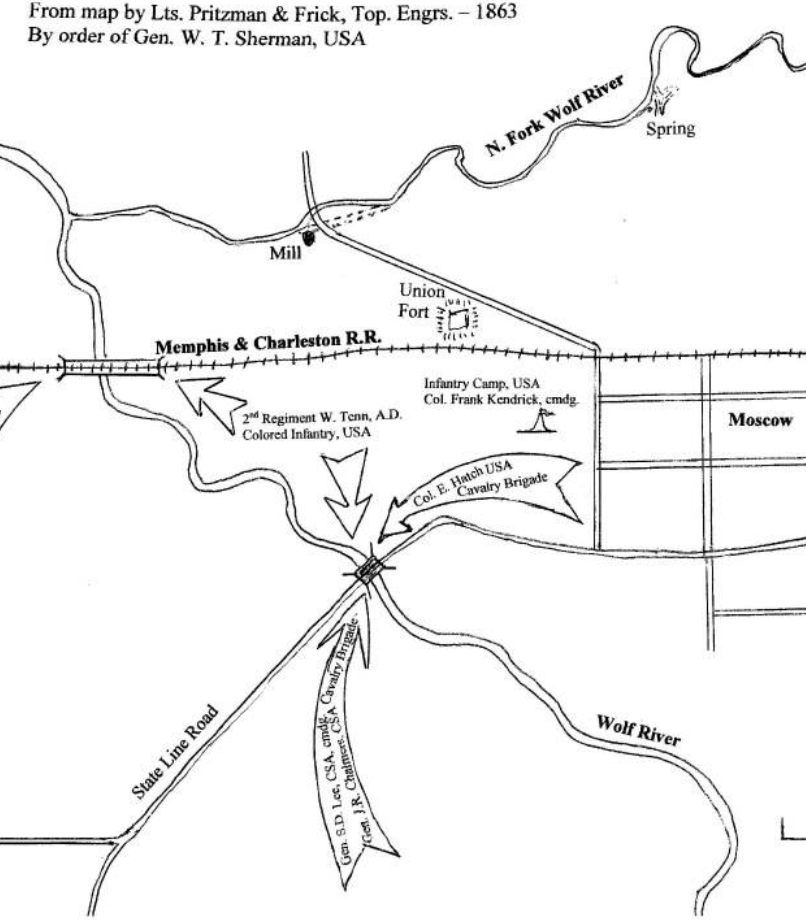
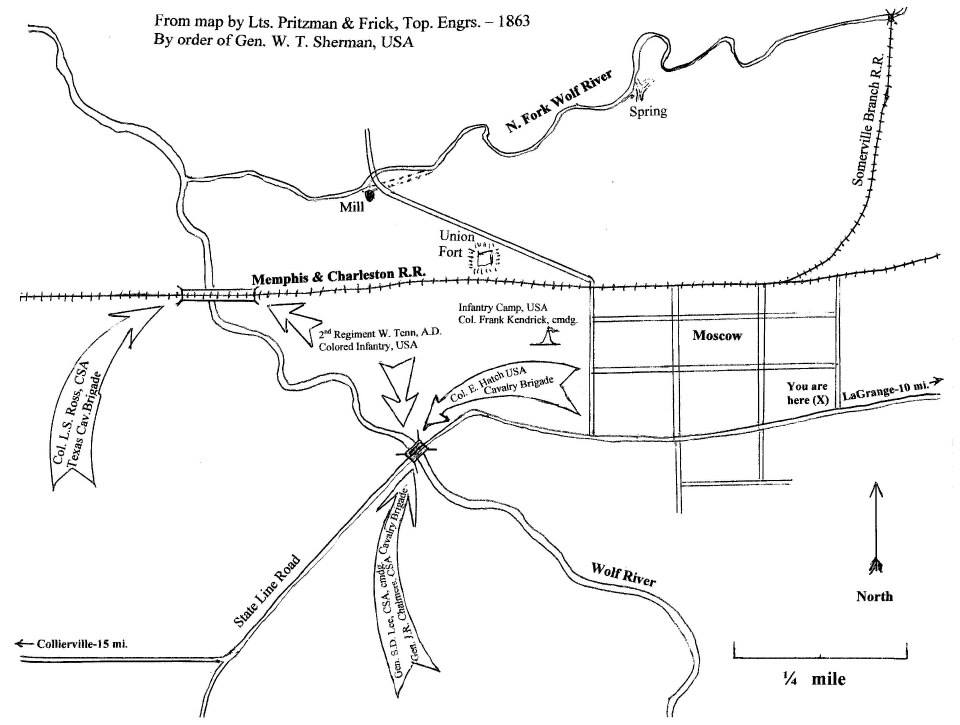
Since it became known to me that the road was threatened by a considerable force of the enemy, I have taken every precaution to guard my position against surprise. To this end the wagon bridge across Wolf River, on the main Collierville road, about 300 yards southwest from my camp, being the most practicable approach to this position, has been the object of especial vigilance. The planks of the bridge are put down only when the bridge is in use for legitimate and authorized crossing.
At 3 p. m., December 3, a small cavalry force made a demonstration on this bridge, dashing up on the gallop even to the bridge, and firing on the pickets stationed there. I immediately re-enforced the pickets with two companies, and after a few rounds had been exchanged the enemy retired. My loss in this affair was two guns, and 1 man severely wounded. That of the enemy is not known, his dead and wounded, if any, being carried away.
During the succeeding night and the next day I kept my regiment in constant readiness for attack, and reconnoitered all the approaches to as great a distance as it could be safely done without the assistance of cavalry.
Early in the afternoon of the 4th, observing a dense smoke in the direction of Grisson’s Bridge and La Fayette, I concluded that the enemy had passed here and gone in that direction. This was likewise the opinion of the officers of the Sixth Illinois Cavalry, which arrived here at 1.30 p. m., in the advance of Col. Hatch’s cavalry brigade, and accordingly such of the cavalry as had arrived were proceeding on the road toward Collierville.
The Sixth Illinois and a portion of another regiment had crossed the bridge—the same upon which the demonstration of the preceding day had been made—when they fell into an ambuscade of the enemy a short distance beyond the bridge.
At the sound of the first scattering shots I supported my picket at the bridge with Companies A and D of my regiment, deploying these companies across the road behind rifle-pits, and in position to sweep the bridge with their fire. The picket guard, about 50 strong, under Capt. Harris, of my regiment, I posted on the left of the road, in the bottom next the river, in such position as to secure a cross-fire on the bridge.
I ordered Lieut.-Col. Foley, of my regiment, with Companies B and G and portions of two others, to take position on the right of our line and hold the railroad bridge over Wolf River, a structure of much importance. The remainder of my regiment I posted in an unfinished fortification, situated on the railroad, 350 yards distant from the wagon bridge, with Maj. Wiley in command.
Although I was the senior officer present at this time, I did not take command of the cavalry, being in momentary expectation of the arrival of Col. Hatch, who was reported to be a short distance in rear with the remainder of his brigade.
Very shortly after the firing the cavalry, which had crossed the bridge, retreated in much disorder. The bridge soon became obstructed with artillery, caissons, and wagons from the train which had got over, and great numbers of the retreating cavalry plunged headlong into the river, which, though narrow, is deep and rapid, and many men and horses were thus lost.
The enemy now made a desperate attempt to force a passage of the bridge, but his impetuous charges were met by the steady and effective fire of the companies posted as I have described.
About half an hour after the fight commenced Col. Hatch arrived, and almost immediately fell severely wounded. I thereupon assumed command of all the forces engaged, which I continued to exercise throughout the engagement.
I now withdrew Company D, of my regiment, and the picket guard from their station at the bridge and ordered them to the fort, supplying their places with two companies of the Second Iowa Cavalry, who were armed with revolving rifles. The efforts of the enemy to gain possession of the wagon-road bridge still continued, and, indeed, did not cease throughout the fight.
Meanwhile, Lieut.-Col. Foley, with his detachment, was vigorously attacked by vastly superior numbers of the enemy, who made desperate efforts to gain the railroad bridge, probably with the design of destroying it, but all their attempts were bravely and successfully resisted.
By my order the artillery in the fort, manned by details from my regiment, under the command of Lieut. Fullen, of the same, was worked throughout the action, and its firing was very effective, several shells striking the wagon bridge where the enemy were charging, and, I am informed by a soldier of the Sixth Illinois Cavalry, who was taken prisoner (but effected his escape during the engagement), that several shells fired from the fort exploded among the led horses of the enemy, producing a panic.
The enemy made a precipitate retreat at ten minutes past 4 p. m., leaving many of his dead and wounded on the field.
The casualties in my regiment are 3 killed and 12 wounded. My men fought in most instances under cover. The enemy’s losses are not known, but must have been very heavy, as he left 22 killed and 4 wounded on the field, and citizens report that he carried many wagon-loads of dead or wounded with him on his retreat.
In this engagement we took 8 prisoners, 5 of whom were wounded. Three of the latter died, and the other 2 were sent to Dr. Irwin, chief of hospitals, at Memphis. The 3 unwounded prisoners were sent to Gen. Tuttle, at LaGrange, as I had no secure place to keep them.
The officers of my regiment, without exception, acquitted themselves with great credit. The majority of the men were for the first time under fire, but their conduct did not disappoint my most sanguine anticipations, as, after the first few rounds, they received and returned the enemy’s fire with the steadiness and deliberation of veterans.
Among the officers of other regiments who were distinguished for gallantry were Capt. Moore, commanding Rifle Battalion, Second Iowa Cavalry, and Capt. Perkins, of the Ninth Illinois Cavalry, and in command of the howitzers attached to that regiment, who, by their determined resistance, contributed much to the success of our arms.
I have the honor to be, sir very respectfully, your obedient servant,

FRANK A. KENDRICK, Col. Second Regt. West Tennessee Infty., A. D., Comdg.