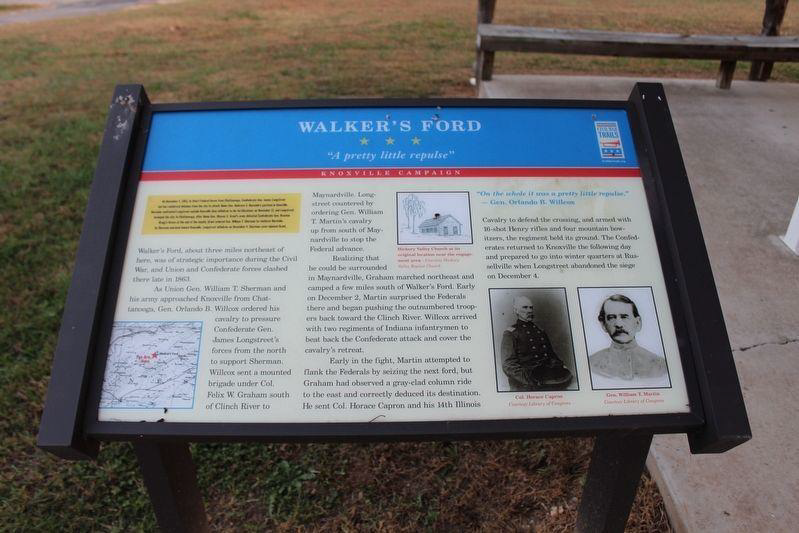
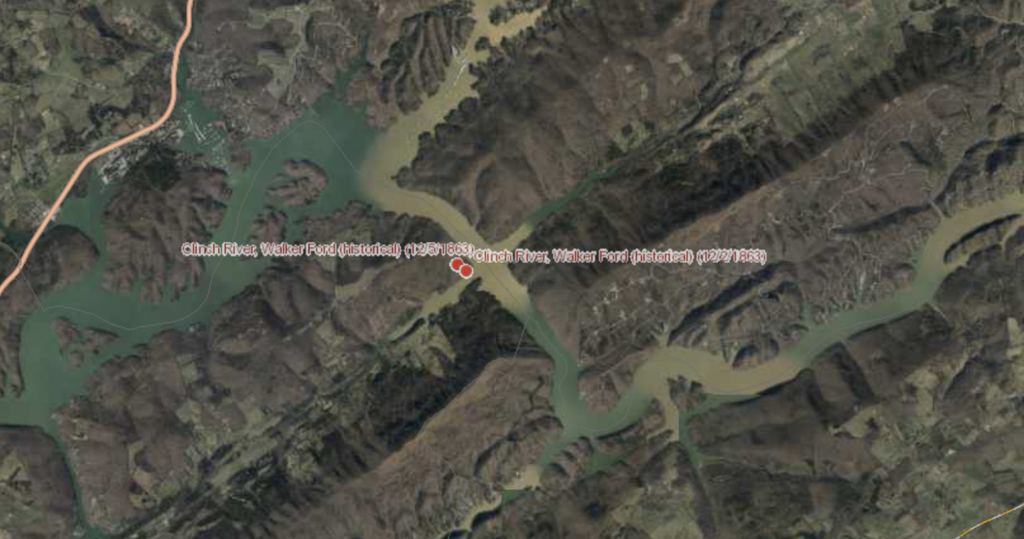
Reports of Brig. Gen Orlando B. Wilcox, U. S. Army, commanding Left Wing United States Forces in East Tennessee.
INTERSECTION IRWIN’S AND WALKER’S FORD ROADS, December 2, 1863—1 p. m.
A messenger who left Walker’s Ford 12 o’clock brings word from one of my staff officers at the ford that Col. Graham is skirmishing with enemy about 2 miles from the ford and is falling back gradually. Col. Jackson is at the ford. This point is 5 miles from the ford, and I have sent word to Jackson to see if he needs re-enforcements. Part of the brigade of reserve with the battery took the middle road instead of the Irwin Ford road, and I am waiting to hear from Jackson before concentrating at this point.
It may be that the troops on the other road will be needed at the ford; if so, they will have a better road than from here. If you decide to send a regiment of cavalry to re-enforce Graham, Col. Foster is at Tazewell, and you can communicate directly with him.
O. B. WILLCOX, Brig.-Gen.
Maj.-Gen. FOSTER.
INTERSECTION WALKER’S AND IRWIN’S FORD ROADS, December 2, 1863—1.30 p. m.
Understanding that Jackson is crossing part of his infantry over the river, I have ordered Col. Curtin to the ford, with two regiments and the remaining battery, leaving one regiment here with Col. Mahan. I shall now proceed at once to Walker’s Ford. I understand that Col. Graham feels no uneasiness about his ability to withdraw, that he is falling back slowly, and that the main body of the enemy is on other side of the mountain.
O. B. WILLCOX, Brig.-Gen.
Maj. Gen. JOHN G. FOSTER, Tazewell.
WALKER’S FORD, December 2, 1863—5 p. m.
After quite a struggle to-day, our troops remain in possession of Walker’s Ford. A regiment of infantry held the road on the opposite side of the river until toward dusk. The enemy withdrew after in vain having attempted to force our infantry line. They seemed to draw off both to their left and right. There are only two companies picketing Needham’s Ford.
Col. Graham’s brigade expended all their ammunition, and will require to be replenished by morning. Col. Jackson lost about 10 killed and 20 wounded, and Col. Graham’s loss will not exceed 25 or 30.
O. B. WILLCOX, Brig.-Gen.
Maj. Gen. JOHN G. FOSTER, Tazewell.
ONE AND A HALF MILES FROM WALKER’S FORD, December 2, [1863]—9.30 p. m.
GEN.: The following dispatch has just been received from Col. Jackson, commanding forces at ford:
I sent 80 men with a commissioned officer 2 miles in advance; found the enemy in camp, and thought they were preparing to move. I have sent parties to watch their movements. All is quiet at the ford above; One hundred and twenty-ninth in good position. While the One hundred and twenty-ninth Ohio were taking their position, the enemy opened on them from opposite side of the river. They were answered by the One hundred and twenty-ninth and silenced. The enemy have one regiment and two pieces of artillery. The foregoing is from good authority.
~ ~ ~
Very respectfully,
O. B. WILLCOX, Brig.-Gen.
Maj. Gen. JOHN G. FOSTER.
ONE AND A HALF MILES FROM WALKER’S FORD, December 3, 1863—8 a. m.
The North Carolina regiment that remained across the river last night, sent out scouts during the night who reported that the enemy were retiring toward Knoxville; none are visible in our front this morning. I hear nothing from them at the lower fords, and have ordered a regiment of cavalry across the river and will try and find out what has become of them.
Patterson’s battery of Napoleon guns, that did such good work yesterday, is reported immovable on account of the condition of the horses for want of forage. Two of the horses died yesterday. I don’t know what we can do unless you order down ten spans of horses from the First Tennessee Battery at the gap, which would give Patterson’s battery 8 horses to a team. The harness must accompany the horses.
Very respectfully,
O. B. WILLCOX, Brig.-Gen.
Maj.-Gen. FOSTER, Tazewell.
ONE AND A HALF MILES FROM WALKER’S FORD, December 3, 1863—1 p. m.
GEN.: I have just received the following dispatch from Col. Graham: Col. Capron, 5 miles from the river, reports the enemy 5 miles in the advance still retreating. He does not state the direction, but I suppose toward Knoxville.
Very respectfully, yours,
O. B. WILLCOX, Brig.-Gen.
Maj. Gen. JOHN G. FOSTER, Tazewell.
ONE-HALF MILE FROM WALKER’S FORD, December 3, 1863—1.45 p. m.
GEN.: Your dispatch just received. The ammunition came down in due time. After waiting till something had to be done for forage, I sent the remainder of Graham’s brigade across the river, where it will go into camp about a mile and a half from the river.
I sent you a prisoner, taken yesterday, from whom I learn that the enemy had two brigades and a battery in the fight, and one in reserve. Armstrong was present with Harrison’s and Dibrell’s brigades, of Wheeler’s cavalry. Carter’s brigade was back toward Maynardville.
Our officers estimate the enemy’s loss at least 100 killed. They endeavored to gain Graham’s rear by a flank movement through one of the side gaps near the river, but were severely punished. They made several bold charges in the road, exposing themselves, and suffered accordingly. Citizens report that our artillery damaged them considerably. On the whole it was a pretty little repulse.
Respectfully, yours,
O. B. WILLCOX, Brig.-Gen.
Maj. Gen. JOHN G. FOSTER, Tazewell.
FOUR MILES FROM WALKER’S FORD, December 3, 1863—6 p. m.
GEN.: I forward dispatches received from scouts. Prisoners will be forwarded in the morning. One of them by the name of Smith, First Tennessee, was attached to Gen. Jones’ headquarters; told him the night before the fight that he was going to Blain’s Cross-Roads. It is possible that while Wheeler’s brigade started toward Kingston, Jones’ command will move up toward Virginia to cover Longstreet’s left flank.
There is no doubt that Col. Dibrell was wounded and Assistant Adjutant-Gen. Allison killed in the affair of yesterday.
O. B. WILLCOX, Brig.-Gen.
OR, Ser. I, Vol. 31, pt. I, pp. 394-397.
SIR: I have the honor to report that, in accordance with orders, I marched from camp, near the bridge over Powell River, on main Cumberland Gap road, on 27th November, 1863.
My brigade consisted of the Fourteenth Illinois Cavalry, Col. Capron commanding; Fifth Indiana Cavalry, Lieut.-Col. Butler commanding; Sixtyfifth Indiana Mounted Infantry, Capt. Hodge commanding, and Colvin’s (Illinois) battery, Capt. Colvin commanding. Beside the four guns of Colvin’s battery, there were four mountain howitzers, attached to Fourteenth Illinois Cavalry, and two 8-inch rifled guns, attached to Fifth Indiana Cavalry.
My entire force numbered 10 field and staff officers, 47 company officers, and 1,031 non-commissioned officers and enlisted men, making an aggregate of 1,088.
I moved, via Tazewell, taking the Straight Creek road at that point to within 4 miles of Walker’s Ford, where I encamped for the night. On the morning of the 28th, I crossed Clinch River and bivouacked at Brock’s, 4 miles from Walker’s Ford, where my command fed. Toward night, moved down the right-hand road, recrossing Clinch River at Headham’s Ford, and camped for the night near Head ham’s Mill.
On the morning of the 29th, I moved down Clinch River to Ensley’s Ford, where I crossed and took the direct road to Maynardville, where I camped for the night.
On the morning of the 30th, I marched with all of my available force on the main road leading from Maynardville to Knoxville, having previous to starting sent a detachment of Fifth Indiana Cavalry in advance with orders to go to the enemy’s pickets and report back as soon as they were found.
I had proceeded 15 miles, when a courier reported a small rebel patrolling party on the road, about 4 miles in advance of my main force, and which my advance had driven in. I halted my command at this point, and remained there some time, awaiting further information. On learning there was a force of rebels at or near Blain’s Cross-Roads, I moved back to Maynardville and camped for the night, throwing out strong picket force and small patrol parties on all the roads on the front and left.
On morning of December 1, my pickets were attacked at the gap, 4 miles below Maynardville, on Knoxville road. They were speedily re-enforced by detachments from each regiment and two of the Fourteenth’s howitzers. More or less firing took place during the day, both parties holding their ground.
Scouting parties were also sent out in considerable force during the day. The one on the road leading to Blain’s Cross-Roads was driven back, and during the afternoon I had such information as led me to believe that a considerable cavalry force of the enemy was approaching, and by 9 p. m. I became convinced that an attempt would be made to surround and capture my command.
I decided at once to move, but several of my scouting parties being several miles out I could not get my force concentrated till near midnight, when, all being in, I moved quietly on the road to Walker’s Ford, leaving Company M, Fifth Indiana Cavalry, at the point where the road from Blain’s Cross-Roads comes in, with instructions for a part of it to patrol the road back to Maynardville; proceeding on to Brock’s, I halted that the men and horses might be fed. This was about 5 a. m., December 2.
Forage parties were sent out, and rations were being issued as daylight appeared, and my pickets in rear of camp were vigorously attacked. Although my command was tired, men sleepy and hungry, and the natural condition of my camp, after a night’s march, somewhat irregular, yet all were under arms and in shape to repel the attack in the very shortest possible time.
I immediately sent the Fourteenth Illinois Cavalry to the river and down the road leading from Walker’s Ford to Rutledge, feeling confident that I could, with the remainder of my force, keep the enemy in check and make good my retreat to and across the river. Two guns of Colvin’s battery were sent to Walker’s Ford, with orders to cross and take position on the bank of the river so as to command all the approaches to the fords.
By half past seven o’clock my pickets had fallen back to Brock’s house, the enemy advancing in such numbers as to compel them to give way at this time. My main force was in position, the Sixty-fifth Indiana on the left of the line, a portion of the Second and Third Battalions, Fifth Indiana Cavalry in center, and one company of the Sixty-fifth Indiana, and one from the Fifth Indiana Cavalry on right.
The guns of the Fifth Indiana Cavalry were put in position in rear of center, on a rise of ground, from which they did good service in keeping the enemy in check. Three companies of Fifth Indiana Cavalry, under command of Maj. Woolley, and one section of Colvin’s battery, under Capt. Colvin, were placed in reserve.
The firing had now become somewhat brisk, and the enemy not only showed his force, but made attempts to flank my position. I could only prevent him from doing so by gradually falling back, which I did, to the point near Yeadon’s house, where I brought my command into close order, and under cover of a fence and a log house or barn.
The enemy here made a charge in column, which was splendidly met by a portion of each regiment, and which proved decidedly disastrous to the enemy.
My artillery had now been retired, the information of the ground on which it had to pass being unsuited to its use. The enemy being exhausted [exasperated] at their repulse pushed on furiously, but the gallant officers and men of my command were not to be driven back so easily; on the contrary, they manfully contested every foot of ground, falling back slowly to a point about 1 mile from the river, where they were re-enforced by the One hundred and sixteenth and One hundred and eighteenth Indiana Infantry, Col. Jackson commanding brigade.
These regiments being in position and my men being out of ammunition, I retired my force across the river, thus ending the fight, so far as the Fifth Indiana Cavalry and Sixty-fifth Indiana Mounted Infantry were concerned. Colvin’s battery was engaged for some time after in shelling the enemy, and the Fourteenth Illinois Cavalry was also engaged for a short time after on the road leading to Rutledge.
I respectfully refer you to the report of Col. Capron, herewith attached, for an account of the part the Fourteenth Illinois Cavalry took in repelling the attack and advance of the enemy.
I now come to speak of the enemy, his designs and expectations. After hearing reports of prisoners and the citizens along the line of the enemy’s march, I am confident that there were five brigades of cavalry and mounted infantry brought against my little force, the whole under command of Maj.-Gen. Martin.
The design was to keep my force engaged at the gap, 4 miles below Maynardville, until a portion of their forces could be moved from Blain’s Cross-Roads into the road between me and Walker’s Ferry, and at the same time a sufficient force had been sent around my front (Onsley’s Ford) to blockade the road to that point. At daylight, on morning of 2d Instant, my entire command was to have been surrounded.
The enemy moved on to a consummation of the object he so devoutly wished for, only to find he had surrounded a camp barren of everything save the fires which my [men] had left In good order.
In surrounding my camp he did, however, capture a portion of M Company, Fifth Indiana Cavalry, which had been left to patrol the road back to Maynardville, and were not able to cut their way out.
Finding themselves foiled in their first attempts, they next tried to cut my command off at Walker’s Ford, and that, too, proved a failure, and at the same time cost them a considerable loss in killed, wounded, and prisoners.
From all the information I can get, and having made every effort to get at their loss, I am satisfied they lost 25 killed, about 50 wounded, and 28 prisoners. Maj.-Gen. Martin was wounded in the wrist. Col. Dibrell, commanding brigade, was seriously, if not mortally, wounded. His adjutant-general was killed. Capt.-, who led in the charge, was also killed.
~ ~ ~
Sixty-fifth Indiana Mounted Infantry, 2 men killed and 6 wounded; Fifth Indiana Cavalry, 2 officers wounded and 5 men killed, 10 men wounded and 10 men missing; Fourteenth Illinois Cavalry, 7 men wounded. Total, 2 officers wounded and 7 men killed, 23 men wounded and 21 men missing.
Very respectfully,
F. W. GRAHAM, Col., Cmdg. Brigade.
OR, Ser. I, Vol. 31, pt. I, pp. 426-429.
Note 1
Note 1: Not listed in Dyer’s Battle Index for Tennessee.