Report of Col. William A. Hoskins, Twelfth Kentucky Infantry.
CAMP AT ALBANY, September 29, 1861.
SIR:
~ ~ ~
This morning I received information that the Confederate forces were forming another encampment at Travisville, distant from us 13 miles. Accordingly I ordered Capt. Morrison to take the effective force under his command and proceed to that point, and after reconnoitering sufficiently to satisfy himself that the number was not too great to justify an attack, to take them by surprise, order a surrender, which, should they refuse, to fire upon them.
In obedience to my orders he proceeded to that point as directed. In about two hours after Capt. Morrison left camp Lieut. Adams joined us, as also the Home Guards of Hustonville Cavalry. I ordered a detail of 15 men from the company under command of Lieut. Adams and 30 from the Hustonville Home Guards, which were placed under command of Maj. Brunets, and he ordered to proceed to Travisville, to support Capt. Morrison in the event he was repulsed; but before reaching that point Capt. Morrison had surprised the camp, finding about 100 troops, which, being ordered to surrender, fled, when they were fired upon and 4 killed, the balance effecting their escape by fleeing to the hills.
~ ~ ~
They also took 4 prisoners, 2 of whom, as also 2 horses, were captured by Thomas Huddleston, a private in Capt. Morrison’s company; after accomplishing which, to use his own expression, “He looked for more, but they had all fled.”
Among the officers with Capt. Morrison were Lieut. Miller, Sergeants Hay, Carr, Chilton, Smith, and Howard. The prisoners were brought this side the line, when, after taking a solemn obligation to prove faithful to the United States Government, they were released. . . .
But for our timely arrival the Confederate troops, I have no doubt, would now have been in possession of this place, as they were to move in this direction on yesterday.
~ ~ ~
OR, Ser. I. Vol. 4, p. 205. Note 2
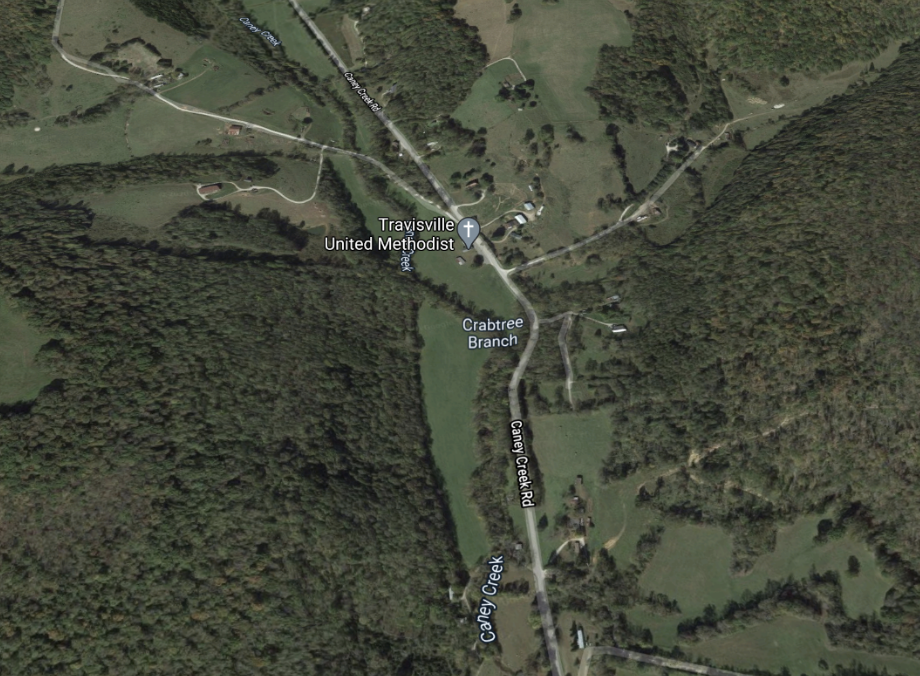
Note 1: This was the first military combat incident of the Civil War in Tennessee. In reaction to a Confederate attack a few days earlier, Union troops from Kentucky entered the state and dispersed a Rebel camp at this Pickett County location. Like the Grand Junction Insurrection, this event seems to have been ignored in previous historical treatments of the Civil War in Tennessee.
The Travisville site has been located by Dr. Michael E. Birdwell and Dr. Calvin W. Dickinson at the History Department of Tennessee Technological University in Cookeville. In the Travisville cemetery they discovered a grave headstone with the following inscription: “James M. Saufley/Killed by James Ferguson of the 1st Kentucky Cavalry, U. S. A. / September 29, 1861.”
The Tennessee Historical Commission, along with the Upper Cumberland Institute at Tennessee Technological University, sponsored the placement of a historical marker at the Travisville site.
Neither E. B. Long, The Civil War Day by Day: An Almanac, 1861-1865, fwd. by Bruce Catton, (Garden City, NY: Doubleday & Company, Inc., 1971) [Hereinafter: Long, Almanac] nor Frederick H. Dyer, Compendium of the War of the Rebellion. . . (Des Moines: 1908, rpt. 1980) [Hereinafter: Dyer’s Battle Index for Tennessee] mention this previously unrecognized event. The otherwise comprehensive Tennesseans in the Civil War, 2 Vols., Vol. I (Nashville: THC, 1964), [Hereinafter: Tennesseans in the Civil War] likewise make no reference to the affair at Travisville.
Note 2: See also OR, Ser. I. Vol. 4., pp. 284-285. However, the Confederates did not stay dispersed for long as the following indicates:
CAMP AT ALBANY, October 1, 1861—8 a.m.
Brig.-Gen. THOMAS:
SIR:. . . I learn that the Confederate troops are rallying again at Travisville, with the intention of attacking us. From the best information, they cannot muster a force exceeding 1,150.
Last night at 9 o’clock our picket guards were fired upon by a party of seven persons within 3 miles of the camp; they returned the fire, with what effect I have not ascertained. None of ours were injured that I know of, though one of the picket has not yet come up.
I have ordered a detachment of fifty cavalry to scout the whole country in the neighborhood of the beat at which the pickets were stationed, as also that in which the absent picket was stationed.
~ ~ ~
Very respectfully, your obedient servant,
W. A. HOSKINS, Commanding Post.
OR, Ser. I, Vol. 4, pp. 286-287.
MCCLARIES’, PULASKI COUNTY, KENTUCKY, October 29, 1861.
Brig. Gen. GEORGE H. THOMAS, Commanding First Kentucky Brigade:
GEN.:
~ ~ ~
I learn that they have also a body of cavalry stationed at Travisville, numbering 1,200, which of course will join their main force at Albany, making in the aggregate 4,400. I have no fears from an attack should it come from the direction of the main road leading from Monticello, but apprehend that they may attempt to flank us by crossing lower down the river. . .
~ ~ ~
Respectfully, &c.,
GEO. H. THOMAS, Brig.-Gen., U. S. Volunteers, Commanding.
OR, Ser. I, Vol. 4, pp. 323.