
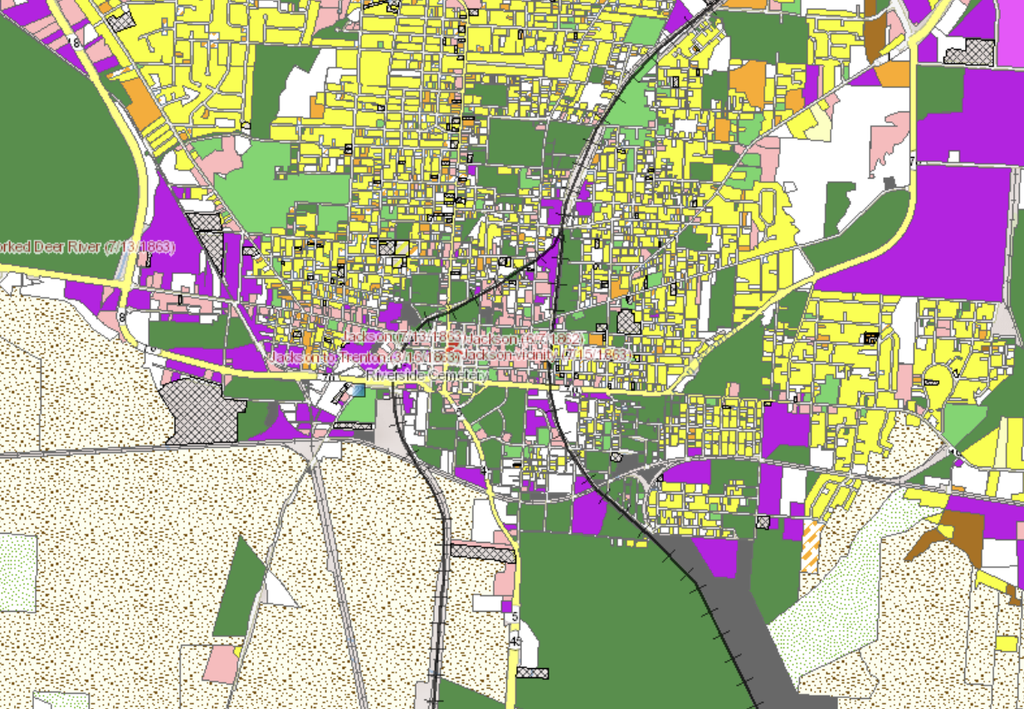
July 13, 1863 – July 15, 1863 – Skirmishes Note 1 at Forked Deer River, occupation of Jackson and skirmish at Spring Creek, Note 2 Madison County
Report of Col. Edward Hatch, Second Iowa Cavalry, commanding Expedition.
HEADQUARTERS SECOND CAVALRY BRIGADE, LaGrange, Tenn., July 19, 1863.
In compliance with orders of Col. Mizner to proceed to Jackson, there attack and disperse the Confederate force at that point, then scour the country in that vicinity, returning to LaGrange as soon as possible, left camp on the morning of the 12th of July, with 360 of the Third Michigan, 300 of the Second Iowa, and 200 of the First West Tennessee Cavalry.
Marched northeast through Bolivar, camped 14 miles from there on the Denmark road, and was joined there by the Ninth Illinois Infantry, 300 strong.
Moved on the morning of the 13th to Denmark. There learning the enemy were concentrating, and, in compliance with the order of Col. Biffle [Confederate commander], posted through the country, all squads and companies and parts of regiments were to meet at Jackson for organization, pushed on immediately by the Brownsville road, sending Col. Hurst with the First Tennessee Cavalry round by the Woodville road, the only approach to the town where the bridges crossing Forked Deer River and sloughs were left standing.
Companies of the Third Michigan Cavalry, commanded by Capts. Nugent and Dyckman, carried rapidly in a lively skirmish all the bridges but the three nearest the town (there are sixteen in all). The enemy, having a very strong position, held the last three bridges until the Ninth Illinois could drive out the enemy’s skirmishers on the right, and two companies of the Third Michigan had crossed the stream well up on the enemy’s left.
As soon as our men had opened on the flanks, and one of the Third Michigan guns had shelled the woods on the right of the bridges, I ordered Capt. Nugent and Capt. Latimer’s companies, of the Third Michigan Cavalry, to charge and carry the bridges, which was quickly and gallantly done.
Capt. Reese and Capt. Lattimer, of the Third Michigan, with their companies, quickly taking possession of a log house on the enemy’s left, held them in check until the howitzers of the Third Michigan had shelled the woods in front.
Leaving two companies to guard the bridges, moved my lines forward, the Ninth Illinois Infantry on the left, the Third Michigan in the center, with the saber companies of the Second Iowa on the right flank, and the Second Iowa Rifles in reserve, our skirmishers driving the enemy toward town, where he had taken a strong position, holding two forts on the south side of Jackson and the curtain connecting them with dismounted men, with mounted men on the left in line and in force sufficient to overlap my right.
The Ninth Illinois had approached the forts within 300 yards when the enemy poured in a volley too high to do any hurt. Col. Phillips took them immediately in a dash so rapid that the rebels had not time to reload, many throwing down their arms and flying in great disorder.
At the same moment of Col. Phillips’ attack, the enemy’s mounted force in large number threatening a charge, I charged them with the saber companies, riding down and breaking up their line. The enemy’s flight had then become a thorough rout, our mounted rifles and sabers charging them in every direction.
Many of the companies were 6 miles east and north of town, and scarcely had the Ninth Illinois Infantry rallied on the northwest side of Jackson, and collected its men, when Biffle (Confederate), with his regiment and one battalion of Roddey’s old regiment, in all 800 strong, approaching on the Trenton road, attacked the Ninth with great spirit, and, by constantly outflanking Col. Phillips, compelled him to fall back.
Rallying four companies on his right, of the Second Iowa and Third Michigan, drove the enemy back, holding him in check until my lines could form in force enough to whip him.
Biffle, with his Confederate reenforcements, had gradually concentrated the broken forces first attacked and scattered, consisting of Cols. [J. A.] Forrest’s, [N. N.] Cox’s, and [J. F.] Newsom’s regiments, with a dozen or more detached companies, with the evident determination of driving us back.
On my right were six companies of the Michigan and Iowa Rifles, in the center the Ninth Illinois Infantry and one howitzer, and on the left six companies of the Second Iowa Rifles. Col. Moyers, with a portion of the Third Michigan, was holding in check a force on my right and rear.
At the moment of attack I was obliged to send the First Tennessee Cavalry, about 200 strong, to check Roddey’s battalion, which attacked my left and rear. The enemy then attacked with great spirit, coming on rapidly in the face of sharp firing, forcing the left, and the Ninth Illinois, in the center, back to a ridge near town.
Wheeling my right to the left, I drove out the enemy pressing the Ninth Illinois. I then advanced the entire line rapidly, driving the enemy from ridge to ridge, advancing my guns, and shelling the forts and rifle-pits on the north side of the town, killing many of the enemy.
On the right the enemy were broken and flying before Col. Moyers. It was then nearly dark. I immediately pursued them on the different roads from 10 to 15 miles.
The night was very dark and foggy, and it was impossible for me to ascertain the direction in which the enemy had fled—supposed it was the Trenton road.
At daylight in the morning learned they were retreating in detachments toward the Tennessee River, and that [R. V.] Richardson, with 400 men, was crossing the Hatchie at Estenaula.
Sent the First Tennessee Cavalry eastward, toward Lexington, with orders to return by the way of Mifflin, Montezuma, and Bolivar, or Montezuma and Purdy; the Ninth Illinois Infantry by Bolivar, to Pocahontas; the Third Michigan by way of Denmark, Dancyville, Wesley’s, and Somerville, and the Second Iowa by Estenaula, Whiteville, and Newcastle.
The women of Jackson, previous to our attack on the town, carried ammunition for the enemy in a very gallant manner under fire. During the attack on the town, the enemy barricaded the streets and fired from the windows. Lieut. Humphrey, of the Second Iowa, was wounded severely from shots from a window.
On one street, however, two companies of flying rebels were mistaken, in the smoke and dust, for our men, and were badly handled by a party of the enemy behind a barricade.
Our men having found thirty barrels of whisky, it gave me as much trouble to save the town from fire during the fight as it did to whip the enemy, and from the same cause we lost a large number of prisoners. I saved the town from burning by the greatest exertions, and protected all the private dwellings.
The stores, I regret to say, were plundered by negroes and stragglers during the fight. In one we found seventeen kegs of powder.
The companies of the Third Michigan, who gallantly carried the bridges, are deserving of great praise. Lieut. Wilson, of the Third Michigan howitzers, shelled the rebels out of a strong position, with credit to his firing.
Col. Phillips fought his men splendidly, advancing at a double-quick 3 miles, driving, killing, and wounding many of the enemy. The saber companies of the Second Iowa Cavalry charged with the greatest boldness.
After we had obtained a foothold north of the river, the enemy was driven so rapidly at all points that his fire was not in the least effective, firing whole volleys over our men.
On my return, Capt. Dyckman, of the Third Michigan, with three augers and four axes, constructed a pontoon at Estenaula, on the Big Hatchie River, 175 feet long, in four hours, over which we crossed the command, our artillery, and wagons in perfect safety.
The enemy had 4 captains, 3 lieutenants, and 31 men killed, and not less than 150 wounded. We destroyed 300 stand of arms and captured about 200 horses.
The conscripts which the enemy had in confinement were allowed to go before we entered the town, and escaped to their homes; said to be from 300 to 400.
There are from ten to fifteen slight wounds, not disabling the men from duty. I have, therefore, not reported these men as wounded.
Very respectfully, your obedient servant,
EDWARD HATCH, Col. Second Iowa Cavalry, Comdg. Second Cavalry Brigade.
OR, I, 24, pt. II, pp. 674-675.


