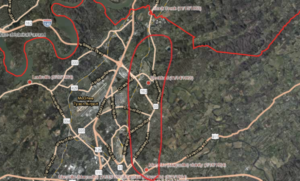
Summary of Engagement (also known as Second Battle of Franklin):
On June 4, 1863 Nathan B. Forrest led two cavalry brigades north from Spring Hill on a reconnaissance to determine the size of the Union force at Franklin. Forrest encountered Union pickets at 3 p.m. three miles south of town along the Columbia and Lewisburg pikes.
Frank Armstrong’s brigade advanced up the Lewisburg pike to the edge of town until halted by a Union cavalry counterattack and artillery fire from Fort Granger. Forrest attacked the Union cavalry positioned between the two pikes with part of James Starnes’s brigade.
A short time later, Forrest ran some artillery with this force up Carter’s Creek pike to approach the town from the west using the town’s structures to cover his men. This successful move largely cleared Franklin of Union soldiers, and Forrest occupied the town.
At this time, Forrest thought he saw a white flag on the fort but was informed by a Union officer that it was a signal flag. While in town, Forrest freed prisoners in the jail and appropriated several sutler stores.
In the meantime, Armstrong sent part of his brigade to cross the Harpeth River southeast of town to cover the main road from Franklin leading east to Triune. This small force was attacked by Archibald Campbell’s Union cavalry brigade and quickly fell back across the river.
Campbell’s attack was the result of Union commander Colonel John Baird’s use of signal flags to request help from General Gordon Granger at Triune. As a result of this Union attack and the approaching darkness, Forrest withdrew.
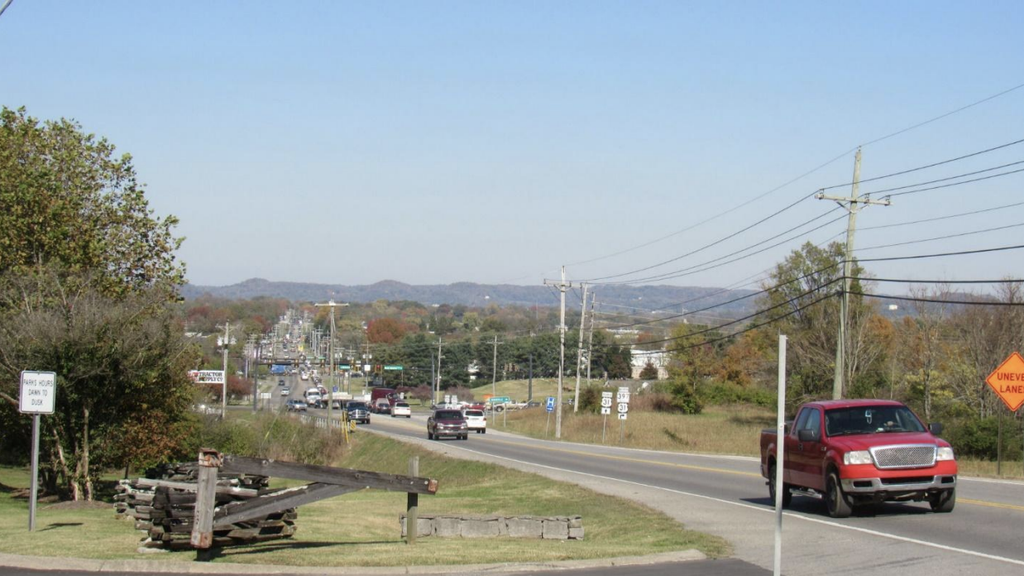
Columbia Pike at Winstead Hill (Starnes’s Brigade)
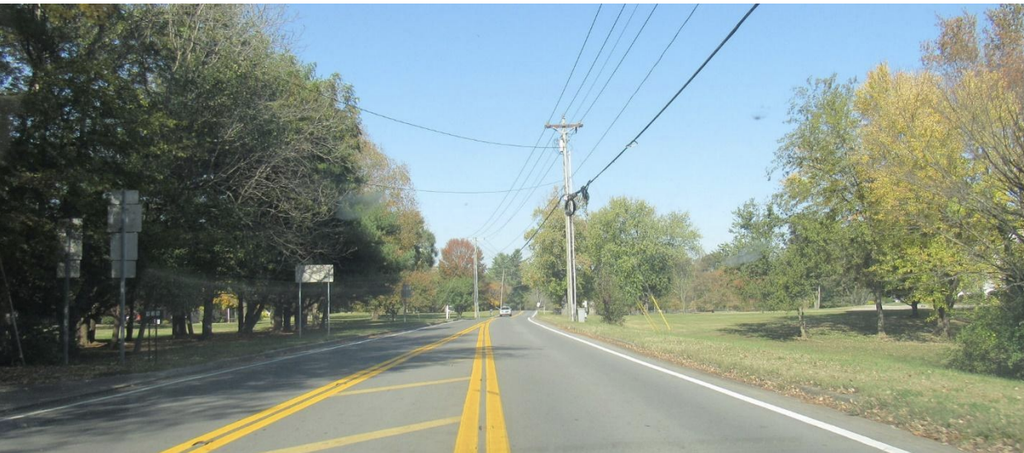
Lewisburg Pike (Armstrong’s Brigade)
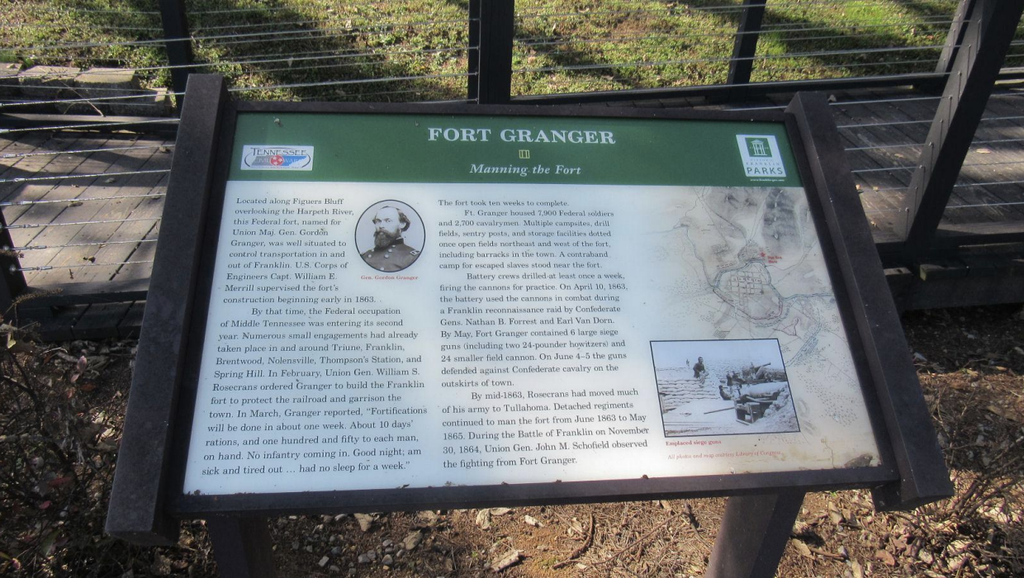
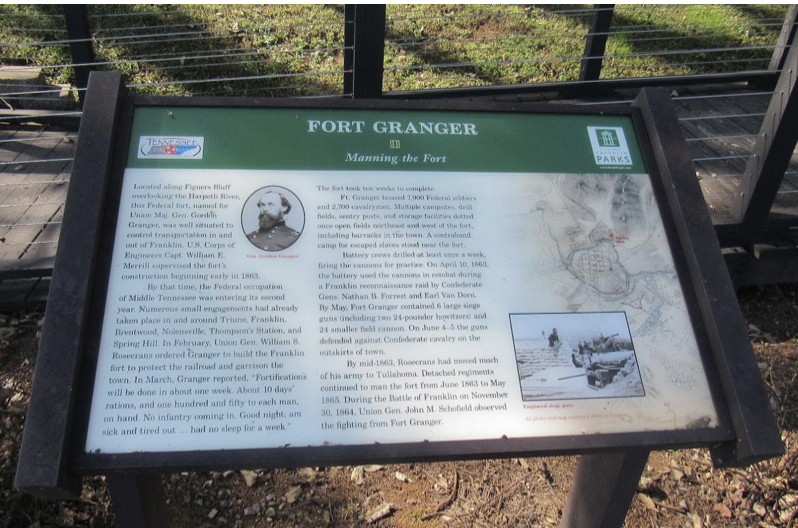
Fort Granger Exhibit
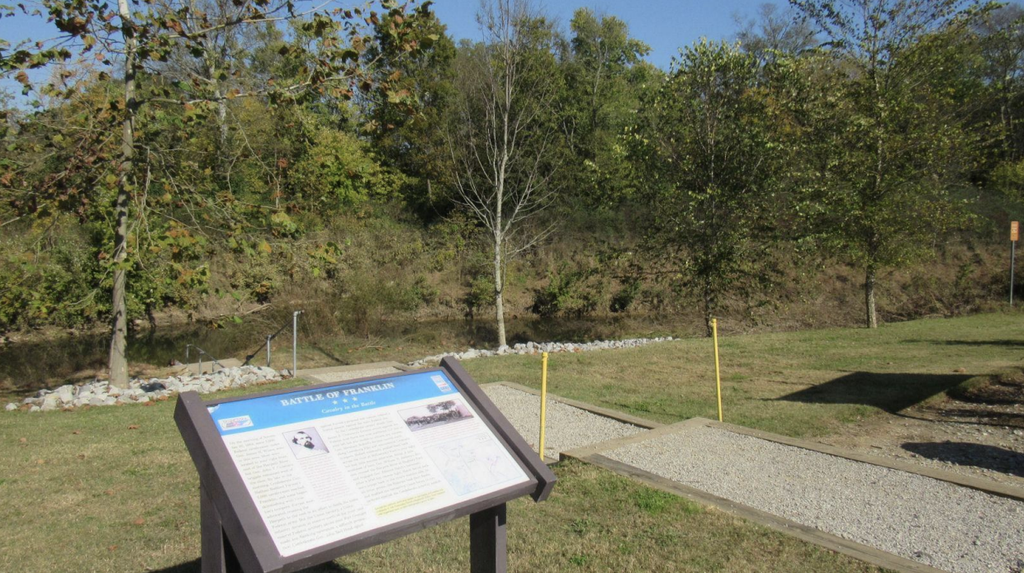
Lewisburg Pike Exhibit
FRANKLIN, Tenn., June 6, 1863.
Rebel covetousness has again led the Spring Hill army of rebels to attempt the capture of this pretty village and important strategic point. They have succeeded no better than they succeeded in their first attempt two months ago. They have wasted considerable powder and several lives; but they are no nearer Nashville on the Franklin pike than they were when the excursion commenced.
THE RECENT FIGHT AND ITS RESULTS—THE FORTS.
Although the fighting and blustering occupied two days its history may be written in a very few lines and the result quickly summed up.
General Granger left Franklin on Wednesday morning last, and moved over to Triune to take command of the United States forces there, leaving a garrison for two of the principal fortifications, under command of Col. J. P. Baird, of the Eighty-fourth Indiana infantry regiment, with instructions to hold the forts at all hazards, as the General himself would have done if he had remained.
One of the forts, situated on the apex of a cone of earth known as Roper’s Knob, two hundred and fifty feet above the level of the plain around Franklin, mounted heavy guns, was garrisoned by a strong regiment of infantry—the Seventy-eighth Illinois—and was tightly considered impregnable.
The other, the principal fortification for the defence of the post, is situated on the bank of the Harpeth, overlooking the town, and one mile from the fort on the knob. Monster guns were mounted here, ammunition was plenty, commissary stores and forage were in abundance and the garrison numerous, consisting of the Eighty-fourth Indiana, Twenty-second Wisconsin and Nineteenth Michigan infantry regiments, and the Seventh Kentucky cavalry, Colonel J. B. Faulkner.
COLONEL BAIRD,
who commanded, was considered a man of determination and bravery, having fought, bled and been captured in the Coburn fight last March. His command was the remnant of Coburn’s old brigade, which escaped from the Thompson’s Station snare, and who have been recruiting ever since, till now they are quite numerous, valorous and formidable.
THE REBEL COMMANDER AND HIS ADVANCE.
This was the situation twenty-four hours after General Granger left, when Major General N. Bedford Forrest appeared before Franklin, on the Columbia pike, direct from Spring Hill, with a force of seven thousand men, mounted, and eight pieces of artillery.
The Seventh Kentucky cavalry, on picket at the time, were drawn up in line to contest the passage to the town, which Forrest’s men seemed bent on visiting. A vigorous and noisy rebel charge succeeded, and the Kentuckians did not wait to receive it. They broke through the town as fast as their horses could transport them—the rebels, paying no attention to the shells from the fort, following closely, so that when the clock struck three they were in complete possession, without the loss of a man.
The public square was filled with rebels, who at once commenced preparations for a protracted stay. Colonel Baird threw three or four shells into the town, but without doing much damage to the rebels.
Forrest visited Judge Marshall—a fat and vicious old rebel—and exchanged congratulations, while dozens of Franklin’s fair daughters, who two days before smiled seductively on men in blue uniform, crowded around with bouquets and benisons.
FORREST’S BEHAVIOR IN FRANKLIN.
In the presence of the fat Judge and the fair rebels Forrest was lion like and chivalrous. He talked of going directly across the brook and taking the fort, while the good people prepared tea to be tasted on his return.
Meanwhile his soldiers were not idle. Stores and sutler shops were broken open, and every valuable thing taken from them. Strange as it may appear, the mercantile business of Franklin was carried on principally by Union men, and the rebels looked upon their goods as lawful plunder.
Young Cliff, son of Dr. Cliff, a Union man, widely known in middle Tennessee, was “completely and thoroughly skinned,” as the phrase is; a Mr. Sinclair, who sold dry goods in a small way, was also robbed, many of the fair ladies who were not busy with Forrest assisting in the operation.
Twelve or fifteen rebels visited the Seminary Hospital, in the village, took a few shirts and paper collars from Surgeon Cleary’s valise, telling him they knew the rules of war as well as he did, burning up a few unimportant papers and ransacking things generally. The sick had been removed to Nashville, so there were no prisoners to parole.
DISPOSITION OF THE REBEL FORCES.
The rebel General was next engaged in disposing his forces to attack the fort in rear as well as in front, and thus end the ball. Armstrong’s brigade was sent to the right and Stearn’s [Starnes’] brigade to the left for this purpose.
During a temporary lull Forrest, who had seen one of Lieut. Hopkins’ white signal flags working, sent a flag of truce to Colonel Baird. The flag was borne by an extremely courteous young rebel officer, whose first salutation was, “Ah! you’ve surrendered have you, God **** you?”
Colonel Baird’s officer, under the influence of passion, with more regard for strength than beauty in a reply, remarked to the rebel, “Not much, you God damned fool!” This ended the peaceful conference, and warlike operations were at once resumed.
General Armstrong, with his rebels, fifteen hundred strong, proceeded to turn Colonel Baird’s left by crossing the Harpeth at Hughes’ Ford, three miles east from the fort, in the direction of Murfreesboro, near the scene of General Stanley’s fight during Van Dorn’s attack on Franklin.
THE CAVALRY FIGHT.
Armstrong fell in with Colonel A. P. Campbell’s brigade of cavalry, which had been sent from Triune by General Granger as soon as he learned of the attack. Colonel Campbell’s command was composed of the Second Michigan (his own regiment), the Ninth Pennsylvania, Colonel Thomas Jordan; the Sixth Kentucky, Colonel Wickliffe Cooper, and the First East Tennessee, commanded by Colonel Brownlow—a fighting son of the fighting parson.
The Unionists were riding hard, the Sixth Kentucky in the advance, closely followed by the Second Michigan. The country was thickly wooded, and the sun but half an hour high, and objects were scarcely distinguishable at a distance of three or four hundred yards.
Armstrong’s force lay concealed in the wood between the Murfreesboro road and the Harpeth until the Sixth Kentucky had passed and the head of the Second Michigan was within forty yards, when they opened fire, expecting to throw the blue coats into confusion.
Majors Godley and Ben. Smith were at the head of their respective battalions, and the attempt failed. Six companies of the Second and four companies of the Fourth Kentucky were dismounted and brought up, when the fight commenced in good earnest.
Rebel prisoners say Armstrong recognized the revolving rifles of the Second and admitted his concern for the safety of his force. The firing was rapid and deadly, and the rebels were driven from cover till they finally broke and fled, leaving seventeen killed, twenty-five wounded and eighteen prisoners.
CAPTURE OF ARMSTRONG’S REBEL BATTLE FLAG.
Armstrong himself narrowly escaped. His beautiful battle flag is in possession of the Michigan men, and the prisoners are nearly all members of his body guard.
Colonel Campbell recalled the Sixth Kentucky, which had dashed past the rebels, and resumed his march toward Franklin, which place he reached at eight o’clock. Col. Watkins, the “gobbler,” with the Sixth, rejoined Colonel Campbell, after having destroyed an ammunition wagon, captured several prisoners and dispersed the guard of the train.
Two men of the Second Michigan killed and two wounded was the sum of our casualties on the first day; and to Colonel Campbell is due the credit of saving Franklin that day.
Acting Brigadier Stearns, whose attack was to turn Baird’s right, succeeded in penetrating in the rear of the Franklin forts, and encamped that night between Baird and Nashville.
A company of rebel cavalry hurridly [sic] visited Brentwood, which was abandoned by our forces several days ago. The telegraph wire was cut and a few rails torn from the ties on the railroad in that vicinity, but little mischief was done.
NOBODY HURT.
I came over to Franklin from Triune during the night, with company F, First Missouri cavalry, General Granger’s body guard, expecting to witness quite a sense of destruction, desolation and devastation, dead bodies, dismounted cannon and ruined houses in and around Franklin.
The trip was exceedingly hazardous, considering that armed rebels beset every approach to the town, but I willingly undertook the job in the service of the HERALD. I reached the fort at midnight, rode in without challenge, found a motly crowd of refugees and soldier standing in the rain, and learned with surprise that nobody had been hurt.
THE SECOND DAY.
Next morning (Friday) the rebels showed themselves again beyond the town on the Columbia pike, in their old position. Colonel Baird commenced playing on them at long taw with a great rifled cannon, and they came no nearer.
Skirmishing continued all day, and Colonel Campbell’s cavalry were in line waiting an attack, which was not made.
Colonel Faulkner, of the Seventh Kentucky cavalry, was shot through the groin while chasing a rebel General (supposed to be Armstrong) through the fields. He is dangerously wounded, but will probably recover.
To-day the rebels have disappeared, and I do not anticipate any further bloodless struggle for this place.
Colonel Baird had been relieved from command at his own request, and Lieutenant Henry C. Wharton, United States Engineers, has taken command as the representative of General Granger. If the rebels again occupy the little town across the brook here they will probably be troubled by shells, flying bricks and splinters.