KNOXVILLE, Tennessee, November 15, 1863.
Gen. BURNSIDE, Lenoir’s:
The following just received from Sanders:
WILLIAMS’ MILL, November 15, 1863.
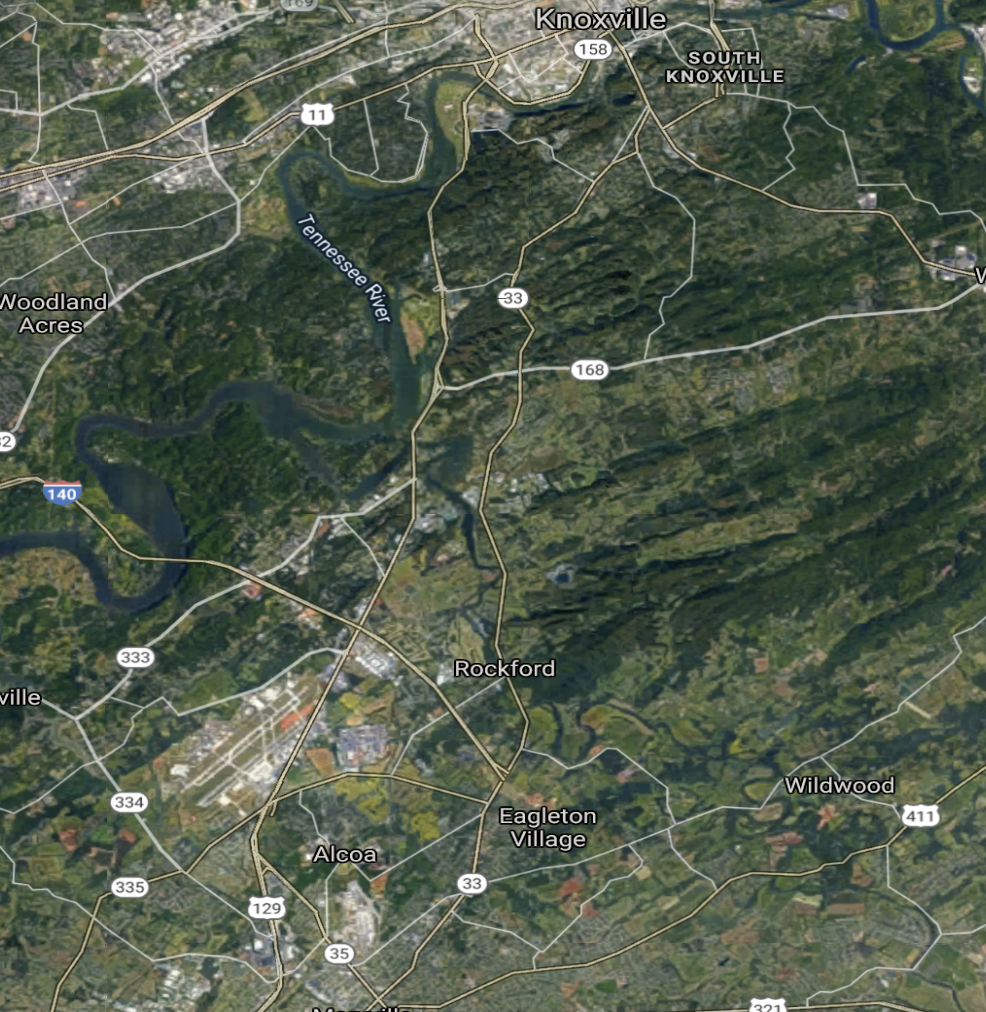
The patrol went into Rockford last night, but met the enemy’s pickets this morning. Some firing is or was, a few minutes ago, going on the front toward Maryville, and also on the right toward Louisville across the river. During the night rockets were seen toward Louisville and also in the direction of the Martin’s Gap road, road leading off to the left and toward the mountains. The road to Sevierville, &c., is open to the enemy.
Some of my regiments did not get rations last night. I have directed my quartermaster to come to you for directions in regard to my wagon train now in Knoxville. Forage is rather scarce here, and he says he has none where he is.
W. P. SANDERS.
OR, Ser. I, Vol. 31, pt. III, pp. 157-158.
Excerpt from the Report of Major-General Joseph Wheeler, C. S, Army, commanding Cavalry Corps relative to skirmish at Stock Creek, November 15, 1863
~ ~ ~
. . . I moved over Little River on the following morning, the condition of the ford making it nearly noon before the entire command was crossed. We pressed upon the enemy, which consisted, as I learned from prisoners and citizens, of Sanders’, Shackelford’s, Wolford’s, and Pannebaker’s brigades, with one battery of rifled guns, all being commanded by Gen. Sanders.
After driving them for 3 miles we came to Stock Creek, which was not fordable for horses, and the enemy had partly torn up the bridge. Just beyond the enemy had taken a strong and elevated position behind a fence inclosing a thick wood, with large fields intervening between the enemy and my position, the ground descending rapidly toward the line occupied by my troops.
The flanks of the enemy from Little River to Knoxville were protected by a high ridge on their left and the Holston River on their right, thus preventing my turning their position and compelling me to fight superior forces in positions chosen by themselves.
To accomplish the desired object I determined to overcome these advantages of the enemy by the vigor of our attack. The enemy kept up a warm fire of artillery and musketry, during which Maj. Burford, of my staff, was slightly wounded. I dismounted nearly half of my command, crossed the creek under cover of a fire from my battery, and drove the left wing of the enemy from its strong position.
This enabled a detail to repair the bridge while I pressed on with the dismounted men, compelling the entire line of the enemy to retreat. Immediately after crossing the creek I sent orders to Gen. Armstrong to move rapidly up the road with his entire command, which up to this time had been held in reserve.
In the meantime we continued to push the enemy with the dismounted men, driving him from several strong positions. After a delay of more than an hour Gen. Armstrong overtook us, and as soon as his command could be prepared we charged the enemy with his command in the following order: The Eighth Texas Regt. in advance, followed by the Eleventh Texas, the Third Arkansas on the flanks, the whole supported by Dibrell’s (Tennessee) brigade.
The lines of the enemy were broken and the entire mass of the enemy swept on toward Knoxville in the wildest confusion. The charge was continued successfully for 3 miles to within less than half a mile of the river opposite the City. The bulk of the enemy dashed over their pontoon in their fright into the City, creating the greatest consternation. Great numbers scattered over the country and many plunged into the river, some of whom were drowned.
One hundred and forty prisoners were taken in the charge and a considerable number killed and wounded. The Federal commander of cavalry was reported in their papers as having received wounds from which he died.
We were only prevented from following the fugitives into the City by a strong force of the enemy’s infantry and artillery in the fortifications on a high hill on the south bank of the river, who opened a heavy fire upon us as we approached.
It being now dusk, and the balance of the command being 4 miles to the rear, after some warm skirmishing I withdrew to Stock Creek, which was the nearest point at which forage could be obtained. The enemy did not come out of their fortifications to follow us.
As I had some reason to believe the enemy might withdraw their forces to the other bank of the river, I returned at daylight and found instead of withdrawing they had strengthened their position during the night, from which they opened warmly upon us as we advanced.
~ ~ ~
OR, Ser. I, Vol. 31, pt. I, pp. 541-542.
November fifteenth, early in the day, the enemy made his appearance along our line and, after several hours skirmishing of both artillery and musketry, General Sanders ordered our skirmishers to fall back gradually. When the enemy fell our line give way he seemed to double his ambition.
I was on the post at the bridge. We sent a courier to the road to get orders when to go in. After the courier arrived at division and regimental headquarters on the Maryville road, the rebels rushed in between our post and the road, so our courier could not return. After waiting full time for his return we started another. In a short time the latter returned, stating that we were entirely cut off.
We struck out in a direction to strike into the Maryville road ahead of the fighting. We (sixteen in number) met an old citizen, who said he would pilot us through. Away he went through the mountains, and we got, and in the course of two hours’ hard riding into the Maryville road just in time to get in ahead of the rebels, crowding on the rear of our marching column.
Our regiment had covered the retreat all this time, and having stood picket all night, and as much as a company two days and night, were becoming very much fatigued-were relieved by the rest of the brigade, the Eleventh Kentucky and the Forty-fifth Ohio mounted infantry.
Just before reaching the heights south of the Holston, the rebels made a furious charge on the two regiments, running into their ranks and shooting them with pistols. We fell back to the heights, where four guns of our battery were in position, supported by three regiments of infantry. Our cavarly force dismounted and formed in position. The battery then opened.
Our regiment was ordered by General Sanders to take position on a very high hill on the right and near the river. After gaining its summit, and throwing forward skirmishers, we halted to take a moment’s rest, when Lieutenant-Colonel Ward, walking along the line, remarked that he was proud to see the regiment get together in such good order after having fought part of two days at such intervals, and not a man hurt.
Here we might note the daring courage and art as skirmishers of a number of our line-officers, shown all the way from Rockford to the Holston. On the first day, that of Lieutenant Higdon was admired by the regiment. Of to-day, that of the above named Lieutenant, Captain Hammer and his First Lieutenant Roff, who are not surpassed on the skirmish line. Also that of Captain Ragsdale.
I think General Sanders is well pleased with the officers and men of our regiment for to-day’s work. It is said by; some of the boys that the General remarked in the morning, that his dependence for the cover of this retreat was in Pennebaker’s mounted infantry brigade.
At the opening of our battery, the rebs, seeing our position and readiness to receive them, fell back. After dark our regiment moved from the hill to the rear of another hill nearer the pontoon-bridge Here we drew rations and camped for the night.
Rebellion Record, Vol. 8, p. 315.
November 18, 1863 – Federal situation report relative to the south side of the Tennessee River
HDQRS., South of River, November 18, 1863.
Lieut.-Col. RICHMOND, Assistant Adjutant-Gen., &c.:
COL.: I have the honor to report for the information of the major-general commanding the state of affairs this side of the river.
We have not been disturbed by the enemy during the day. Last night signal lights were displayed in several places by the enemy on the hills beyond us. A scout sent out in the forenoon reported the enemy’s pickets about 3 miles from our front on the Maryville road.
Not deeming the information reliable, a party of the Eleventh Kentucky, under command of a commissioned officer, was sent forward to ascertain, if possible, the force in our front, if any. The party has returned and reports that there is no enemy this side of Little River. They advanced to the vicinity of Rockford. It was ascertained that the enemy have possession of some boats, with which foraging party crossed and re-crossed during the night.
The enemy’s forces recently here were under command of Wheeler, said to be 10,000 strong, commanded by Davis [?], Armstrong, and Morgan; the latter remained after the others left, but has now followed. The Sevierville road has been scouted for 10 miles; no enemy.
The river is strongly picketed to-night by infantry and cavalry, and we have a deployment extending on a half-circle from the river on the left to river on right of our position. The Sevierville road is strongly guarded by a detachment of the Ninth Tennessee Cavalry, about 3 1/2 miles from the bridge. The Maryville road is picketed by the Eleventh Kentucky Cavalry. The Sixty-fifth Illinois is advanced as a reserve.
Considerable progress has been made in strengthening our main position on the height east of the bridge. Six pieces of artillery have been placed in position, and the works are held by the One hundred and third Ohio and Twenty-fourth Kentucky not otherwise detailed.
I our present front can be held, I have full confidence that a section of artillery, with what infantry can be spared outside the works, will render assistance to our troops on other side.
Very respectfully, your obedient servant,
DANIEL CAMERON.
P. S. -I have just received information that the enemy are preparing to cross the Holston at its junction with the French Broad. Have dispatched a mounted force to contest the passage of the river, and will endeavor to check them.
Very respectfully,
DANIEL CAMERON.
OR, Ser. I, Vol. 31, pt. III, pp. 183-184.