Account of engagement at Anderson’s Cross Roads: October 2, 1863 – Capture of wagon train; skirmish at Anderson’s Cross Roads; allegation of misconduct by Federal forces on Confederate prisoners Report of Col. Edward M. McCook, Second Indiana Cavalry, commanding First Cavalry Division. HDQRS. FIRST CAV. DIV., DEPT. OF THE CUMBERLAND, Winchester, Tenn., October 23, 1863. Maj. —
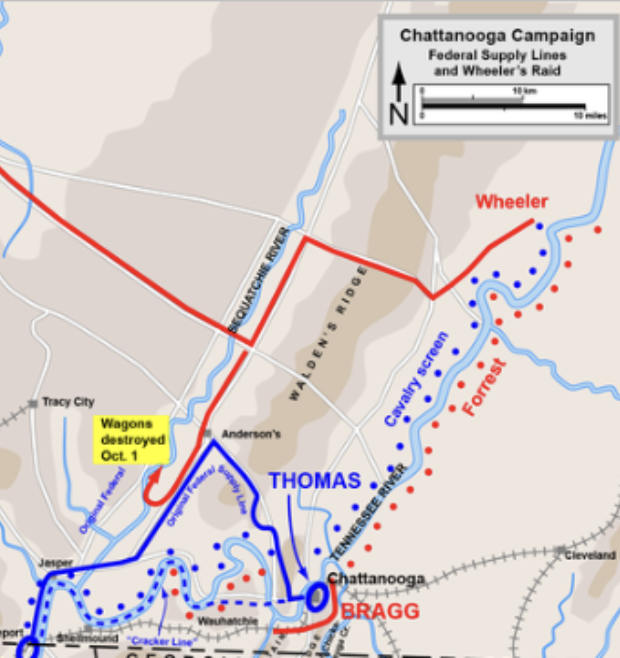
“I have the honor to report that at 11 a. m. of the 1st instant I received a dispatch. . . from department headquarters informing me that the enemy had crossed the Tennessee River in heavy force at or near Washington, with designs upon our trains and communications, and ordering me to move to Anderson’s Cross-Roads. I was at that time, with three regiments, First Wisconsin, Second and Fourth Indiana, and one section of a battery, Lieut. Newell commanding, of the Second Brigade, at Bridgeport, Ala., 45 miles from that point. The other regiment of that brigade (Second East Tennessee) was guarding fords and ferries in the vicinity of Jasper. The First Brigade, with the exception of the Second Michigan, which was at Eyler’s and Rankin’s Ferries, was at Caperton’s Ferry, where they had been placed, pursuant to orders, to observe the movements of the enemy and prevent his crossing in that vicinity. The Third Brigade was at Bellefonte, except the Fifth Kentucky, which was at Kelley’s Ferry. I immediately moved with the three regiments and section of artillery of the Second Brigade, above named, in the direction of Anderson’s Cross-Roads, at the same time dispatching orders to Col. Campbell to move his command with all possible haste and join me at Jasper, giving directions to Col. Watkins, commanding Third Brigade, to move up to Caperton’s I moved at 1 p. m., expecting to reach Anderson’s by daylight, but owing to a heavy and incessant fall of rain, which continued during the whole day and night, the roads became so slippery and full of water that I did not reach Jasper sooner than 8.30 p. m. Expecting to be joined by the First Brigade, I halted, and bivouacked for the night.
On the morning of the 2d, marched at daylight, and at 8 a.m. I dispatched Col. Campbell again to make all possible speed in overtaking me. At 1 p. m. a heavy column of smoke was observed in the direction of Anderson’s Cross-Roads, and a short time after, citizens brought the intelligence that the train had been attacked by a large cavalry force, and was then burning. I moved the command forward at a trot to a point 4 miles from the cross-roads, where I took a by-road across the country, leaving the Fourth Indiana on the main Jasper and Dunlap road to observe any movements that might be made from the direction of Dunlap, and moved on rapidly with the First Wisconsin, Second Indiana and section of Newell’s battery, in the direction of the enemy. The First Wisconsin encountered a portion of the enemy’s force 2 miles south of the cross-roads, and immediately charged, capturing a number of prisoners, and driving them past the burning train upon their main force, which was 1 mile north of the cross-roads, in line of battle. I ordered the Second Indiana to take position, with the right resting upon the base of the mountain, forming one battalion front, with the other two supporting a short distance in the rear, and formed the First Wisconsin on their left in a similar manner. A simultaneous charge was ordered with both regiments, and executed with such vigor that the enemy were dislodged from their position and driven 2 miles across a small creek, where they secured a strong position and erected barricades of rails. The First Wisconsin were then moved off to the left, so as to enfilade the enemy’s line. The Second Indiana at the same time were dismounted and charged upon the right at double-quick. This movement was entirely successful, and the enemy were driven back with considerable loss. The First Wisconsin being mounted charged upon their left, driving them in confusion, taking 40 or 50 prisoners, besides killing and wounding a number with the saber.
The Second Indiana having remounted, both regiments were now sent in pursuit. Several positions taken by the enemy were wrested from them by saber charges, until they were driven across the Sequatchie; when, it having become quite dark, and the men and horses being exhausted from marching since daylight, and five hours of constant and determined fighting, in which the enemy were driven a distance of 8 miles, the command was bivouacked for the night. At 2 a. m. of the 3d, the Fourth Indiana was sent to reconnoiter the front. They crossed the Sequatchie and proceeded to the top of the mountain, 4 miles beyond Dunlap, attacking the enemy’s rear, capturing 6 prisoners and recapturing 200 mules. The result of the whole engagement was the capture of 12 commissioned officers, among whom were Maj. Duff Green Reed, assistant adjutant-general on Gen. Wheeler’s staff; Maj. Morgan, inspector of Martin’s staff, and Capt. May, commanding his escort, and 93 enlisted men, comprising men and officers of twelve different regiments. The enemy lost 7 commissioned officers killed, among them, Maj.-, Capt. Jones, and Lieut. May, and Capt. Smith, besides a number of enlisted men, whose bodies I ordered the citizens to bury. One of their officers, captured four days afterward, acknowledged a loss of 250 killed and wounded. We also recaptured a number of prisoners that the enemy had taken and about 800 mules, besides rescuing a part of the train that had not yet been burned. The enemy shot 200 or 300 mules upon finding they could not escape with them. I cannot speak too highly of the conduct and gallantry of Col. O. H. LaGrange, First Wisconsin Cavalry. To his intrepidity in leading, and skill in maneuvering his regiment, is attributable in a large degree the successful repulse of the enemy. Maj. Presdee, commanding Second Indiana Cavalry, is also entitled to great credit for the brilliant manner in which he led his regiment during the entire engagement. To the officers and men of these regiments I tender my thanks for their gallant and soldierly bearing.
The Fourth Indiana, and Lieut. Newell, commanding battery, though not actually engaged during the day, executed their orders with precision and to my entire satisfaction. Having no orders to proceed farther than Anderson’s Cross-Roads, and having at my immediate command only three regiments, I determined to await orders from the general commanding, lest farther movement on my part might cause disarrangement in his plans. Col. Campbell, with the First Brigade, did not overtake me until the afternoon of the 3d, twenty-four hours later than he was expected to arrive. The delay was unfortunate, and a matter of extreme regret to me, as had the additional force of this command been at my disposal when I encountered the enemy, results of much more importance and benefit might have been secured. For a recital of the ability, energy, and valor displayed by the various members of my staff, I would refer you to any of the usual reports made by military commanders of engagements in which their commands have taken a part. I am, respectfully, yours, EDWARD M. McCOOK, Col., Comdg. Division. OR, Ser. I, Vol. 17, pt. I, pp. 675-677.